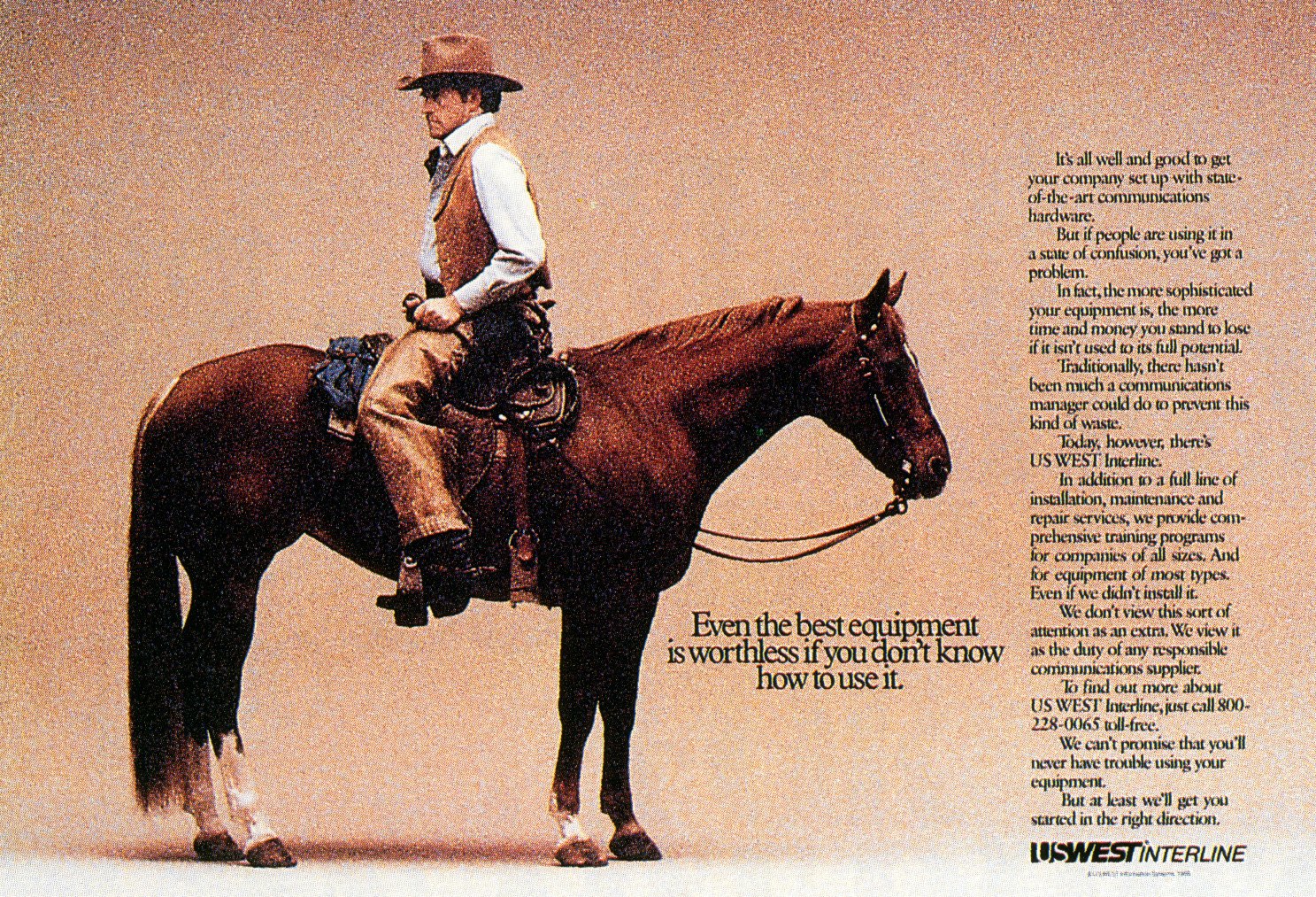
US WEST Corporate Print
A new company created by a court-ordered breakup had to introduce a name nobody knew; it is also the account whose loss in 1988 marked the start of the end of McElligott's time at Fallon.
The era.
For most of the century, American telephone service meant the Bell System. In November 1974 the Justice Department filed an antitrust suit against AT&T. On January 8, 1982, the company settled and agreed to break itself apart within two years.
Divestiture took effect on January 1, 1984. AT&T's 22 local operating companies, about three-quarters of the system's assets, were regrouped into seven independent regional companies. AT&T kept long distance and equipment and gave up the Bell name and the bell symbol for its own use.
One of the seven was US WEST, set up in 1983 and based in Denver. It held three old Bell companies, Mountain Bell, Northwestern Bell and Pacific Northwest Bell, and served 14 states from Minnesota and Iowa to Arizona and Washington. Customers kept dealing with the old names. The parent company was new, and needed to be known by investors, regulators and business customers.
The culture.
The breakup unsettled people. A retired AT&T vice-president said Bell employees felt abused by the process, and customers found themselves passed between the regional company and AT&T when something went wrong. Seven unfamiliar holding companies appeared at once, each with a made-up name and a stock to sell.
Telephone companies had advertised for decades, but as monopolies. Their advertising explained rates, asked for patience or promoted long distance. The new regional companies had to learn to talk like businesses with something to prove.
Minneapolis was Northwestern Bell territory, and Tom McElligott had written its advertising in the 1970s at Bozell & Jacobs, with the art director Ron Anderson. When Advertising Age named Fallon McElligott Rice Agency of the Year in March 1984, its largest client was a local telephone company. By 1986 Inc. listed 'AT&T spin-off U.S. West' among the agency's best-known national clients.
The problem.
On January 1, 1984, three phone companies people knew became one name nobody did.
US WEST was a large company with no history under its own name. It held three old Bell companies, Mountain Bell, Northwestern Bell and Pacific Northwest Bell, across 14 states. Customers kept dealing with those old names, and few could say what US WEST was or why it mattered.
As a new public company it needed standing with investors, business customers and regulators. It also had to show that a former monopoly could think and act like a competitor. Telephone companies had only ever advertised as monopolies, explaining rates and asking for patience. All of this had to be done in print, quickly, from a standing start.
US WEST, one of the seven regional companies formed when AT&T was broken up on January 1, 1984, gave Fallon McElligott its corporate advertising in the agency's early years. The job was to introduce a new holding company that had no name of its own with the public.
The solution.
Introduce a company born of a court order in the voice of someone with an argument to make: one headline, one picture, one point per page.
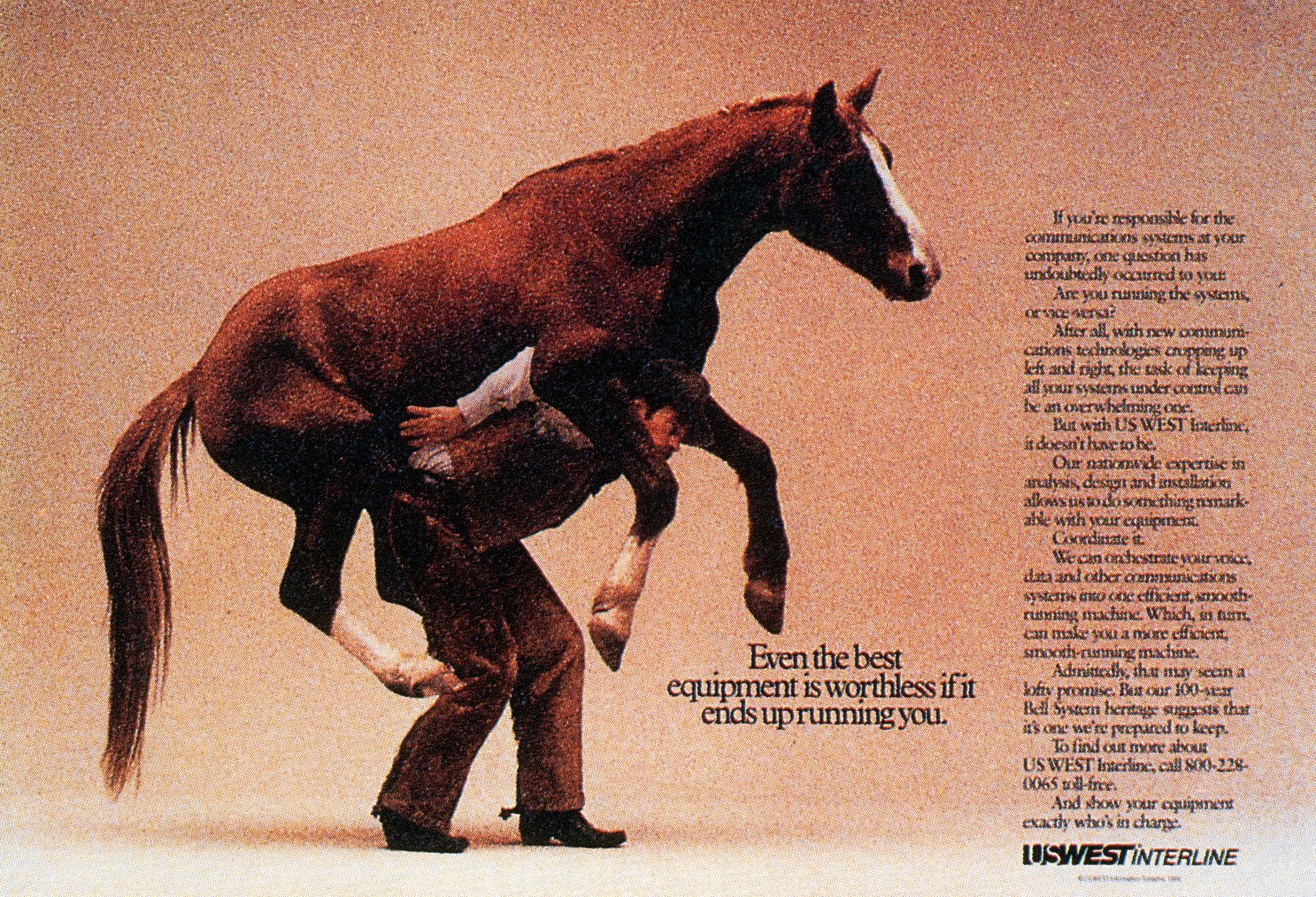
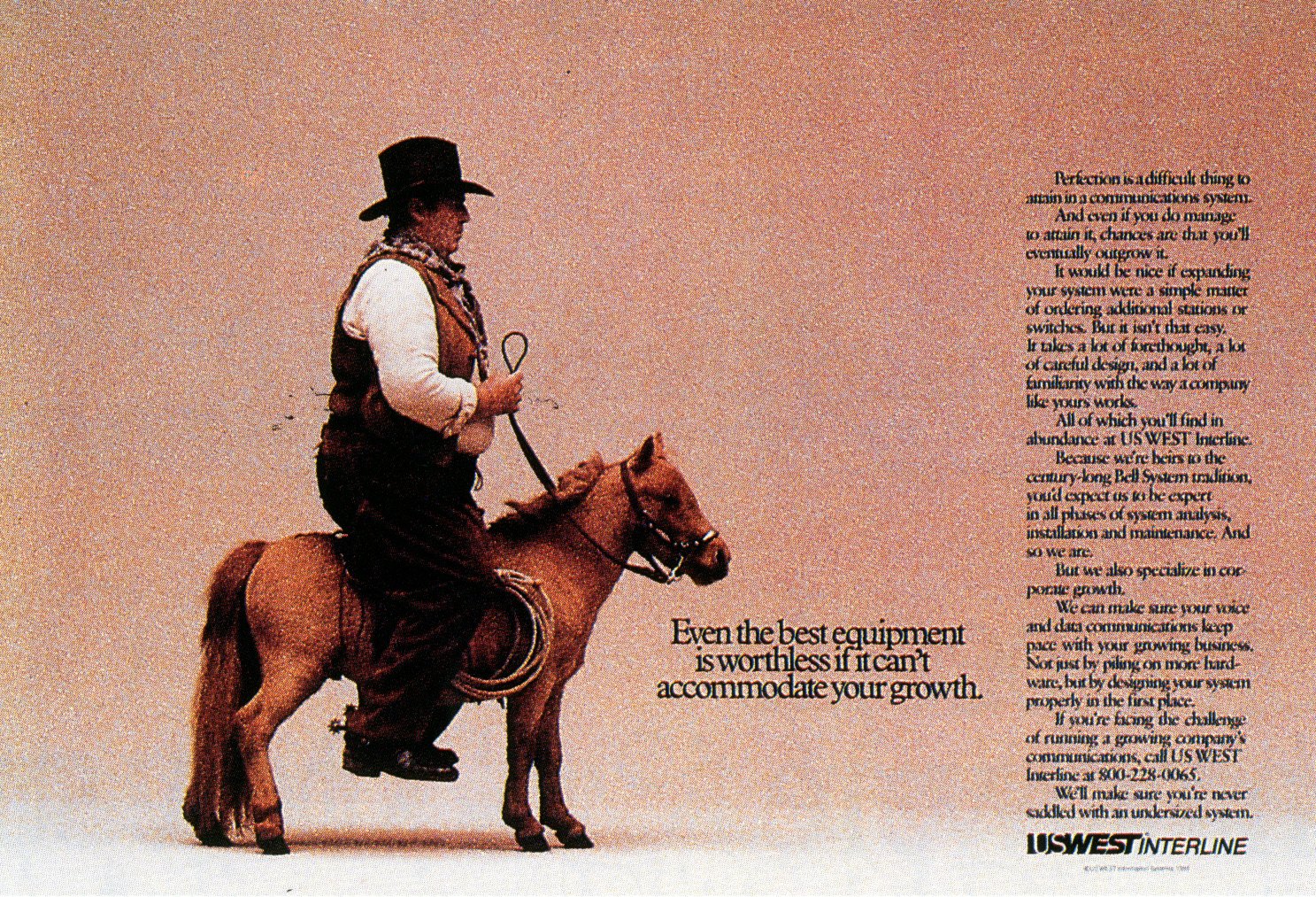
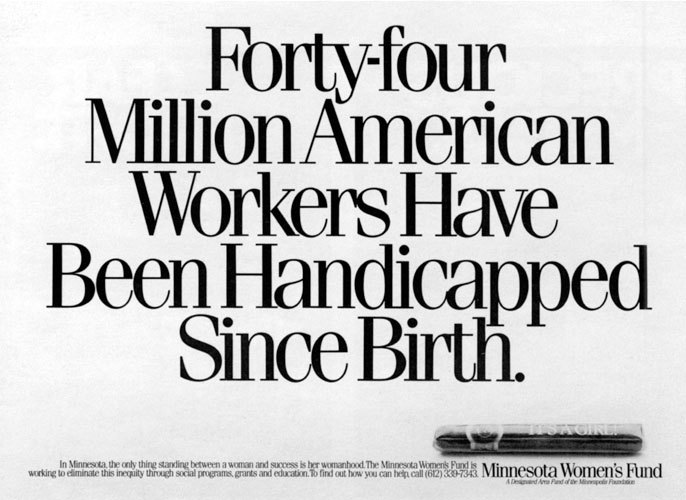
Fallon McElligott made US WEST's corporate print ads in the agency's own manner, the big headline and single arresting image that Mpls.St.Paul Magazine called the Minneapolis style. The surviving scans, which Dave Dye's archive labels 'Backwards', 'Carry' and 'Growth', show a company presenting itself one idea at a time. The account lasted until early 1988. After a mocking reply to a feminist critic went out from the agency in late 1987, US WEST, which had a large and active women's union, became the first client to leave; The Wall Street Journal and Federal Express followed.
The work.
Same shape of problem.
The phone company account that tested whether a breakup could produce a brand, and the client whose exit began the end of an agency partnership.
Back to the archive →