USA Today · Lois Pitts Gershon Pon
Neither Fish Nor Fowl
A new national paper mocked by the trade took the insult, printed it as its own headline, and sold the confusion as range.
The era.
Gannett's chairman Allen Neuharth raised the idea of a national daily at a board meeting in 1979. A secret team spent two years and about a million dollars on prototypes, and in 1981 mailed them out with survey cards headed "Tell us what you think." On 15 September 1982 the first issue was presented at a reception on the Mall in Washington attended by President Reagan, Speaker Tip O'Neill and Senate Majority Leader Howard Baker.
USA Today went on sale that day in Washington, Baltimore, Atlanta, Pittsburgh and Minneapolis, at 25 cents. It looked unlike any other American paper. Stories were short, there was colour on every section front, and the staff designer George Rorick built a full-colour national weather map that papers around the world later copied.
Readers bought it. Paid circulation in the first two weeks of October averaged 221,978 against a projection of 200,000, and by the end of 1982 it was estimated at about 363,000. Analysts put the cost to Gannett at $50 million over two years. In the end the paper lost $233 million before it turned its first profit, in May 1987.
The culture.
The newspaper business took against it at once. Critics called it "McPaper" and "television you can wrap fish in," and said its short pieces were news reduced to snacks. A Montana editor called it "faceless, heartless." Others called it "well-packaged froth."
The criticism reached the people who bought space. Agency media departments read the same trade press as editors, and a paper the trade laughed at was a hard thing to put on a media plan. As one analyst said in November 1982, advertisers "want to know who your readers are," and nobody could yet say.
Gannett's account sat with Young and Rubicam, then the largest agency in the country, which also bought a great deal of space in Gannett's other papers. Changing agencies risked offending a major customer. Cathie Black, who joined USA Today in 1983 and later became its publisher, was the executive who brought Lois in.
The problem.
Readers had decided USA Today was a newspaper; advertisers still couldn't say what it was.
USA Today had readers and no category. It was too short and too colourful to be judged as a newspaper, and too daily to be a magazine. The trade called it McPaper, and every month that passed hardened the label.
Lois's own page put the problem in one line: America took to reading the paper at once, and advertisers stayed away in droves. Arguing that the critics were wrong would only repeat the charge. Gannett needed a way to make the confusion itself a reason to buy space.
Gannett's advertising was with Young and Rubicam, which also ran ads in Gannett's other papers. Cathie Black brought Lois in, and he pitched to a room of Gannett executives with Neuharth present. The task was to get advertisers to buy space in a paper readers had already taken to.
The solution.
Concede the insult in the headline, then make it the selling point.
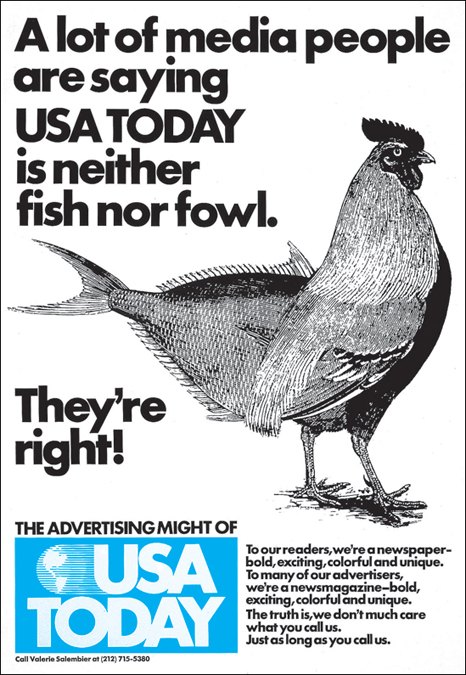
Lois's first ad showed a creature with the body of a rooster and the tail of a fish. The headline agreed with the critics that USA Today was neither fish nor fowl. The copy then argued that it was both, a newspaper and a news magazine at once, and closed: "We don't care what you call us, just as long as you call us." In Cathie Black's account the pitch line was "A lot of people are saying USA Today is neither fish nor fowl. They're right!" and Neuharth, silent behind dark glasses, said "We've got it." Neuharth asked Lois how the industry would read a move away from Young and Rubicam; Lois said it would look as if Gannett had finally got its head screwed on straight, and Neuharth gave him the account. By the fourth quarter of 1985 USA Today was selling 1.4 million copies a day, second among American papers.
The work.
Film
Same shape of problem.
The first ad agreed with the critics in its headline.
Back to the archive →