Jiffy Lube · Lois Pitts Gershon
Jiffy Lube Changes the Way America Changes Its Oil
A handful of oil-change bays got a logo built to steer cars off the road, and a line that claimed the whole category before it existed.
The era.
Through the 1970s most American drivers had their oil changed at a service station or a dealer, on a lift, by appointment or by waiting. In Ogden, Utah, Edwin Washburn opened a shop where cars drove over a pit and were serviced from below, which cut the time of the job. He called it Jiffy Lube and franchised a small number of locations in Utah.
In 1979 W. James Hindman bought Washburn's seven franchises. Hindman had made his money in nursing homes and was coaching football, unpaid, at Western Maryland College. He set up Jiffy Lube International and moved the headquarters to Baltimore. The company dates its own founding to that year, and to what it calls the first drive-through service bay.
When George Lois started work for Hindman in 1982, the chain was still small. Lois counts 18 units, in a few states. The marketing team had just spent $25,000 a store on signs. Quick oil change was a format with no national name attached to it.
The culture.
Franchising was how an American service business grew quickly: a uniform sign, a fixed menu and a promise of speed, copied from town to town by local owners. Hindman's plan was to apply that model to motor oil, and he set out to open franchises across the country through the 1980s.
Hindman ran the company like a team. Lois describes a marketing staff made up of men Hindman had coached, and a pitch meeting that felt like a locker room. That gave an outside agency something rare: a founder who could approve a big idea in one sitting.
The format was new enough that the category had no shorthand. By 1989 trade estimates put about 6,200 quick-lube shops in the country. In 1982 the customer still had to be told that this kind of place existed at all.
The problem.
A new kind of service with a handful of outlets had to look like the national standard before it was one.
Jiffy Lube had a format but no identity that could travel. Its outlets sat on busy roads where drivers passed at speed and decided in seconds.
The company needed franchisees, and franchisees buy a brand that already looks big. It also needed drivers to change a habit and trust a stranger with the car instead of the familiar station.
There was a cost problem too. The company had just paid 25,000 dollars a sign for 18 units, so a new identity meant writing off money already spent. Whatever Lois made had to work on a sign at forty miles an hour and on television at the same time.
Lois began working for Hindman's company in 1982. At the first meeting Hindman introduced him to his young marketing team. Lois insisted the company needed a new logo and design program before any advertising, though the team had just paid 25,000 dollars a sign for 18 units.
The solution.
Make the logo an instruction to turn in, and make the line claim the whole category.
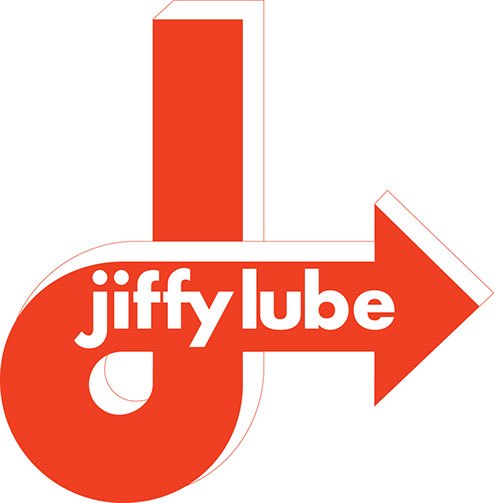
Lois proposed what he called an action logo: a circular J drawn as a curved red arrow, a road sign that bends traffic off the street and into the bay. Over it he put a headline that spoke for the category: "Jiffy Lube changes the way America changes its oil." He presented both to Hindman, the marketing team and the company's lawyer, who worried aloud about the shape of the arrow; Lois answered with a joke and the room approved the work. The idea gave every new franchise the same visible promise of speed. By 1988 Jiffy Lube was the largest chain in the business, with 833 locations; the 1,000th opened that October in Durham, North Carolina. Lois puts the eventual total above 1,600.
The work.
Film
Same shape of problem.
The logo was an arrow designed to pull cars off the road.
Back to the archive →