Tommy Hilfiger · Lois Pitts Gershon Pon
The 4 Great American Designers for Men
An unknown designer was announced as one of the four greats of American menswear, in a Times Square word game, on a budget of about $200,000.
The era.
By the mid-1980s American menswear was led by designers whose names had become brands: Ralph Lauren, Calvin Klein and Perry Ellis. Their names were on shirts, jeans, fragrance and licences, and their advertising ran in every men's and fashion magazine. A designer joined that group through years of press, store placement and seasonal shows.
Tommy Hilfiger came from outside that system. In upstate New York he had run People's Place, a clothing store that grew into a small chain and went bankrupt in 1977. He then freelanced as a designer. In 1984 the businessman Mohan Murjani, who had made Gloria Vanderbilt jeans a success in the 1970s, offered to back a men's sportswear line under Hilfiger's own name.
The Tommy Hilfiger company was founded in 1985 with the Murjani Group's money. The line was preppy American sportswear, close in spirit to Lauren's, with a logo built from nautical signal flags. It had product and a backer. It had no reputation, and very little to spend on making one.
The culture.
Times Square in 1985 was run-down at street level, and its billboards were still watched by commuters, tourists and the newspaper and magazine staff who worked a few blocks away. A board there spoke to the trade as much as to the public.
The fashion business ran on hierarchy. Seventh Avenue, the editors and the department stores decided between them who counted, and newcomers were expected to wait their turn. Lois's own account says the campaign set out to provoke Seventh Avenue, and did.
Lois had spent twenty-five years arguing that one outrageous idea did more than a long schedule of polite ones. He had a record of treating fame as something advertising could manufacture or borrow. Hilfiger, short of money and time, was an ideal client for that view.
The problem.
An unknown designer had to be ranked with the leaders now, with no time and no money to earn it.
In 1985 Hilfiger's name meant nothing to shoppers, buyers or editors. Fashion reputations usually took years of reviews, store placement and seasonal shows.
The leaders in his field had budgets he could not match. Lois says the launch budget was 200,000 dollars, and straight product advertising at that level would have disappeared among the Lauren and Klein pages.
The line needed to be talked about as a peer of the established names from the first week. By Lois's reckoning, the normal route would have taken twenty years.
Hilfiger hired Lois to launch the line with a billboard in Times Square. By Hilfiger's account, Lois told him that advertising the usual way would take twenty years to build a brand, and showed him the idea. Hilfiger later credited "Mohan, Joel, and George" with persuading him to go ahead.
The solution.
Declare the newcomer one of the greats before anyone has heard of him, and make the public fill in his name.
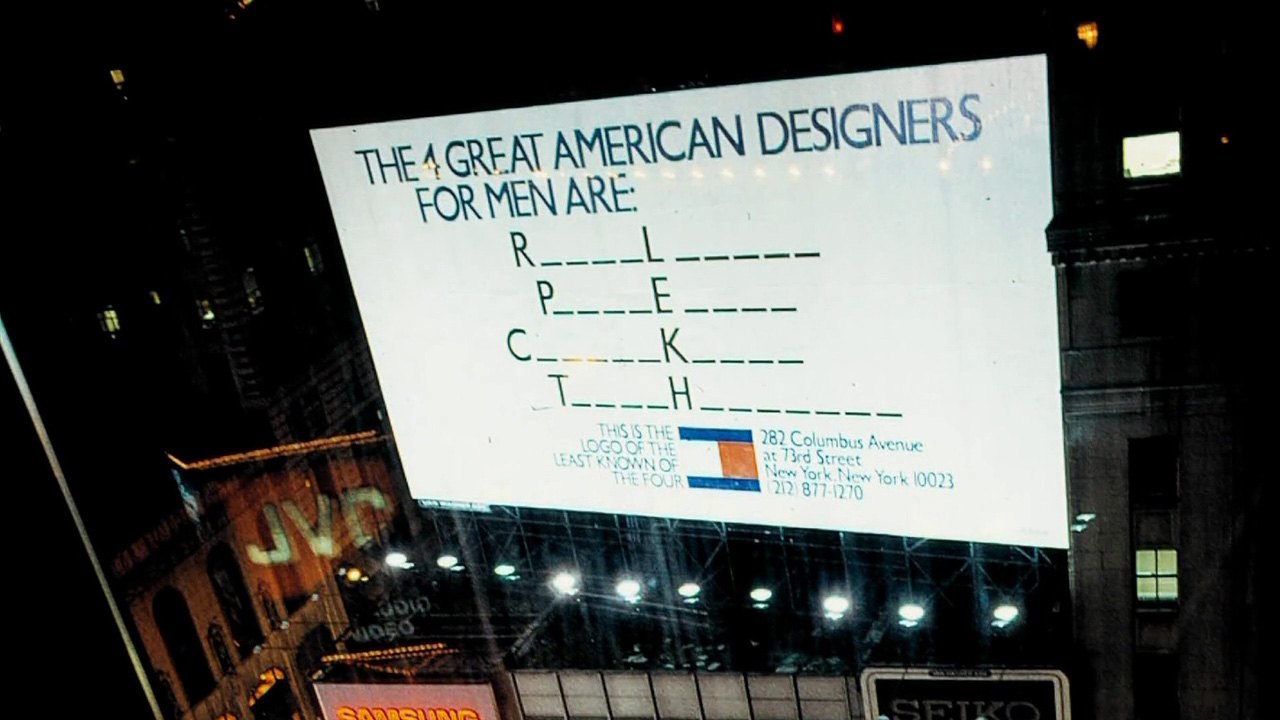
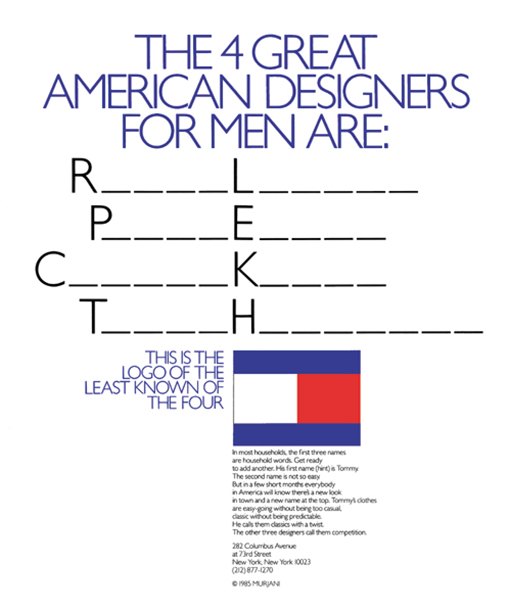
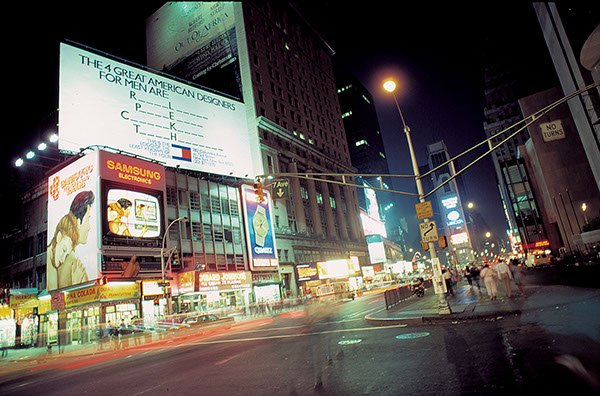
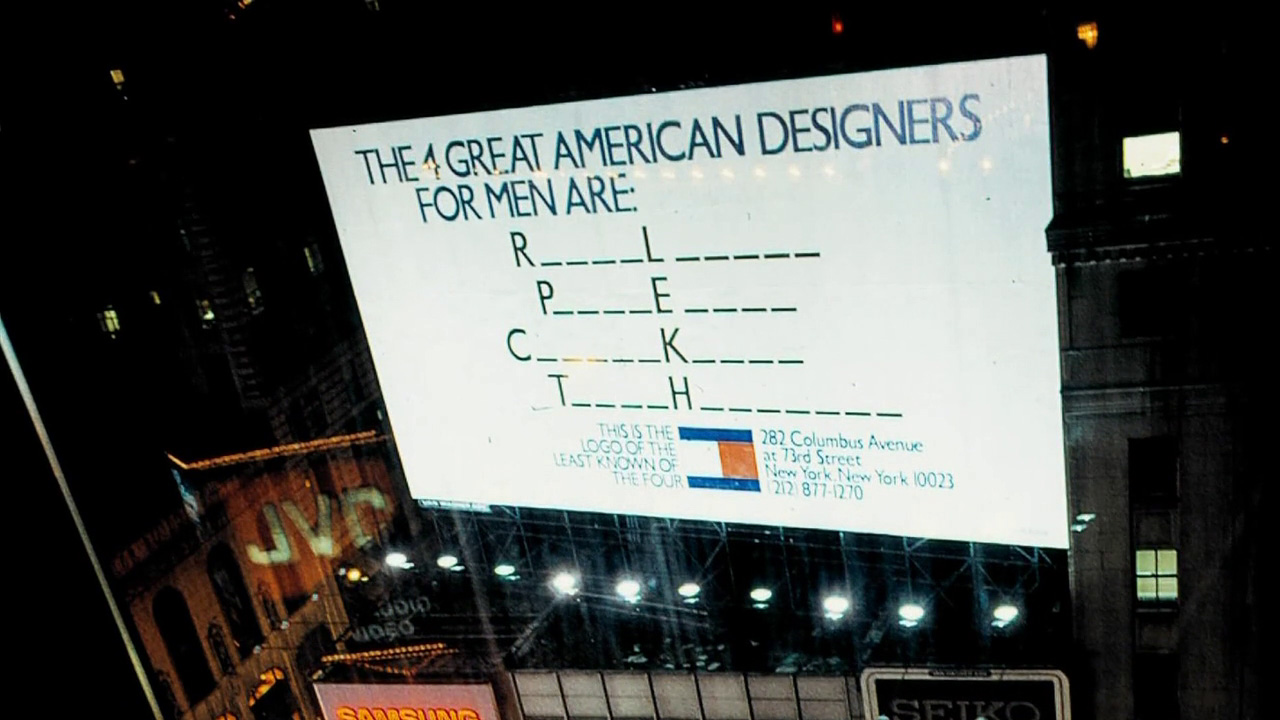
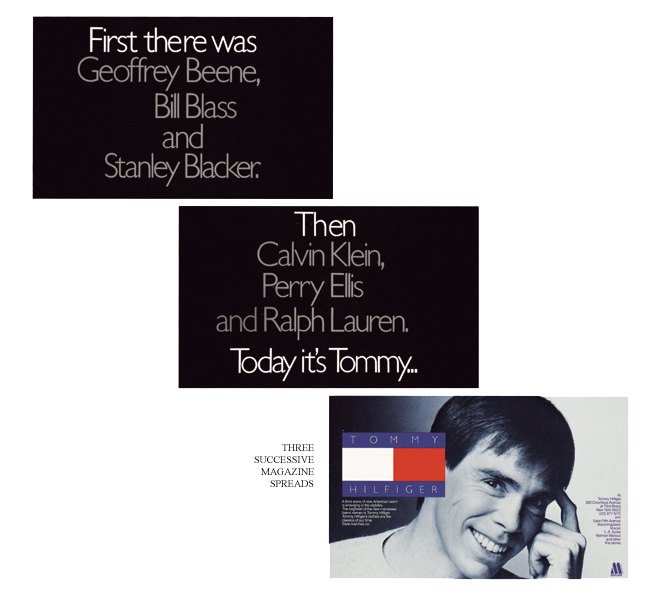
Lois wrote the claim as a hangman puzzle. The headline read "The 4 great American designers for men are:" followed by four sets of initials and blanks: R_ L_, P_ E_, C_ K_, and T_ H_. The copy noted that in most households the first three names were household words, and told readers to get ready for another: "His name (hint) is Tommy." The puzzle ran on a Times Square billboard, in magazines and on New York telephone-kiosk posters. Lois says national publicity followed within days, and three more spreads cast Hilfiger as the leader of a 'third wave' of American designers. Hilfiger later said of the campaign: "You have to be disruptive." The company went public in 1992.
The work.
Same shape of problem.
The designer's name ran in Times Square with most of its letters missing.
Back to the archive →