The era.
The personal computer had arrived in American homes and then stalled. United States personal computer sales grew 11 percent in 1984 to 7.5 million units, after growing 107 percent the year before. Almost all of that growth came from offices. Home computer sales actually fell 4 percent to 4.8 million units against an expected seven million. Charles Martin, editor of Personal Computing, told Time in May 1985 that the business had returned to earth.
Buying a computer meant walking into a specialist shop. ComputerLand, MicroAge and hundreds of independent franchised dealers sold Apple, Atari, Commodore and Osborne machines side by side on the same shop floor. These were small businesses with tight cash and thin margins. The staff were the only product demonstration most buyers ever got, and a dealer's stock was money sitting on a shelf.
Fear of computers was a named and studied condition. Researchers in these exact years were publishing on computer anxiety and computer aversion as measurable phenomena. Jerry Pournelle, writing in Byte in August 1984, noted that the Macintosh attracted people who had previously been intimidated by computers. That was the opportunity and the obstacle in one sentence: the people most likely to want the machine were the people least likely to walk into a shop and admit they did not know how to use one.
The culture.
The test drive was a ritual every American adult already knew how to perform. You walked onto a forecourt, took the keys, drove the car for twenty minutes and handed it back without buying it. Nobody thought less of you. Mike Murray, the Macintosh marketing manager, later made the point that the name was doing most of the work: a promotion called Take a Mac Home for a Night would have failed, because nobody would walk into a computer shop and ask for that out loud.
John Sculley had arrived from Pepsi, where the Pepsi Challenge had made the same bet in a different category. Put the thing in the person's mouth and let the experience make the argument. The logic transfers cleanly to a product whose advantage is a sensation rather than a specification, and the Macintosh was exactly that. Pointing, clicking and dragging had no vocabulary in 1984 and no comparison set.
Christmas 1984 is now described as the last ordinary holiday season for the home computer market as it had existed. The market was saturating, the growth had gone, and the way was opening for dedicated games machines. For Apple it was the final selling window before the financial year closed. Behind the shop floor there were tens of thousands of Macintoshes in warehouses and a monthly sales line pointing the wrong way.
The problem.
Apple had bought every advertising page in Newsweek and still could not explain what a mouse felt like.
The Macintosh went on sale on 24 January 1984 at 2,495 US dollars. It passed Steve Jobs's target of 50,000 units in the first hundred days, reaching about 72,000 by early May, and then the line bent. Total sales for 1984 came to roughly 250,000, about half what Jobs had projected, and the trend through the autumn was getting worse month by month rather than better.
Production had already been ramped to a capacity of 110,000 machines a month, so warehouses filled and orders were cancelled. The Apple II, meanwhile, had its best year ever and was earning about two and a half times what the Macintosh earned.
Apple had already spent its way to total share of voice. It bought every advertising page in the post-election November 1984 issue of Newsweek for more than 2.5 million dollars, a buy variously reported at 39 or 40 pages. The sales line did not move. That told Apple something specific and uncomfortable: this was not an awareness problem. People knew the machine existed and still would not buy it, because the entire argument for the Macintosh was a physical sensation that no advertisement could transmit.
Macintosh sales were falling every month through the autumn of 1984 despite Apple having bought every advertising page in a November issue of Newsweek. Andy Cunningham, who ran Macintosh launch public relations at Regis McKenna, later described the response as diagonal marketing — finding customers anywhere, through factory visits, business demonstrations and the test drive — and said the advertising agency handled the Test Drive a Macintosh programme. Mike Murray, then vice-president of marketing, was the approver who asked whether more money was needed.
The solution.
Stop describing the product and lend it out — but only when the thing stopping the sale is disbelief rather than price.
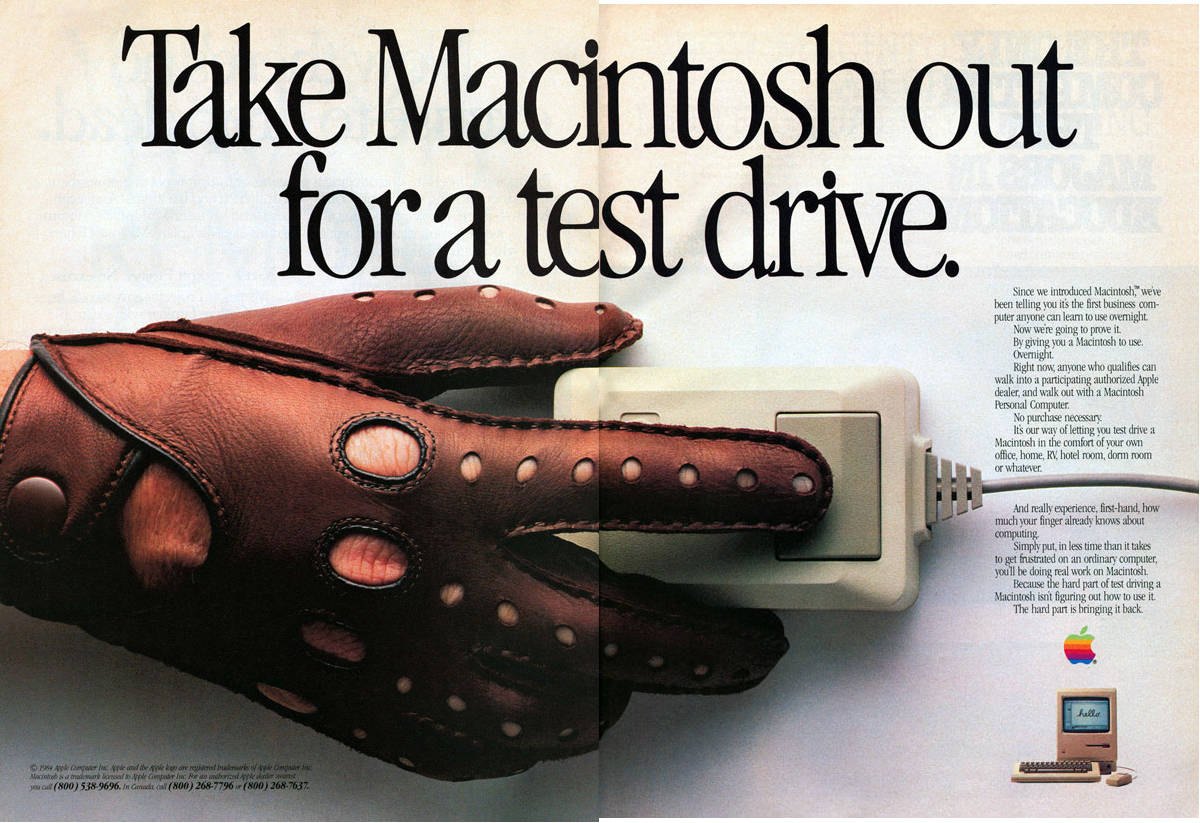
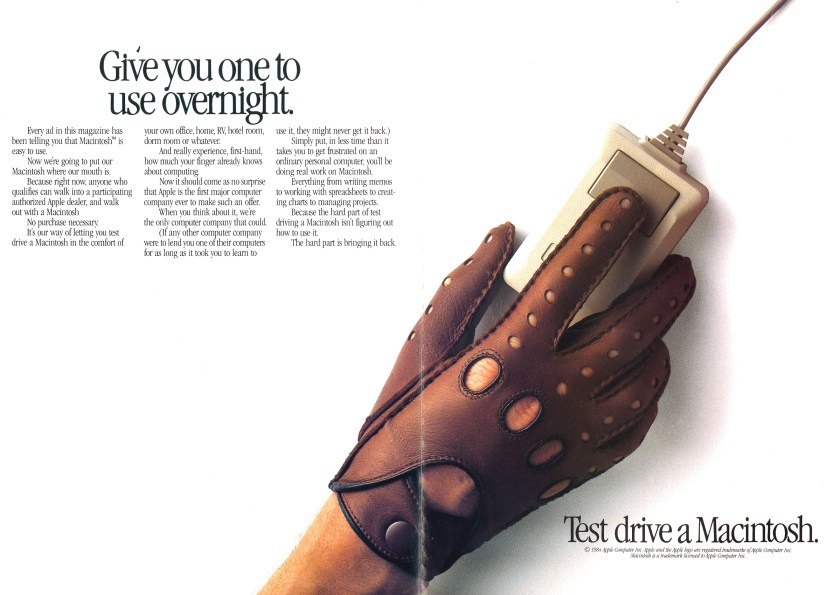
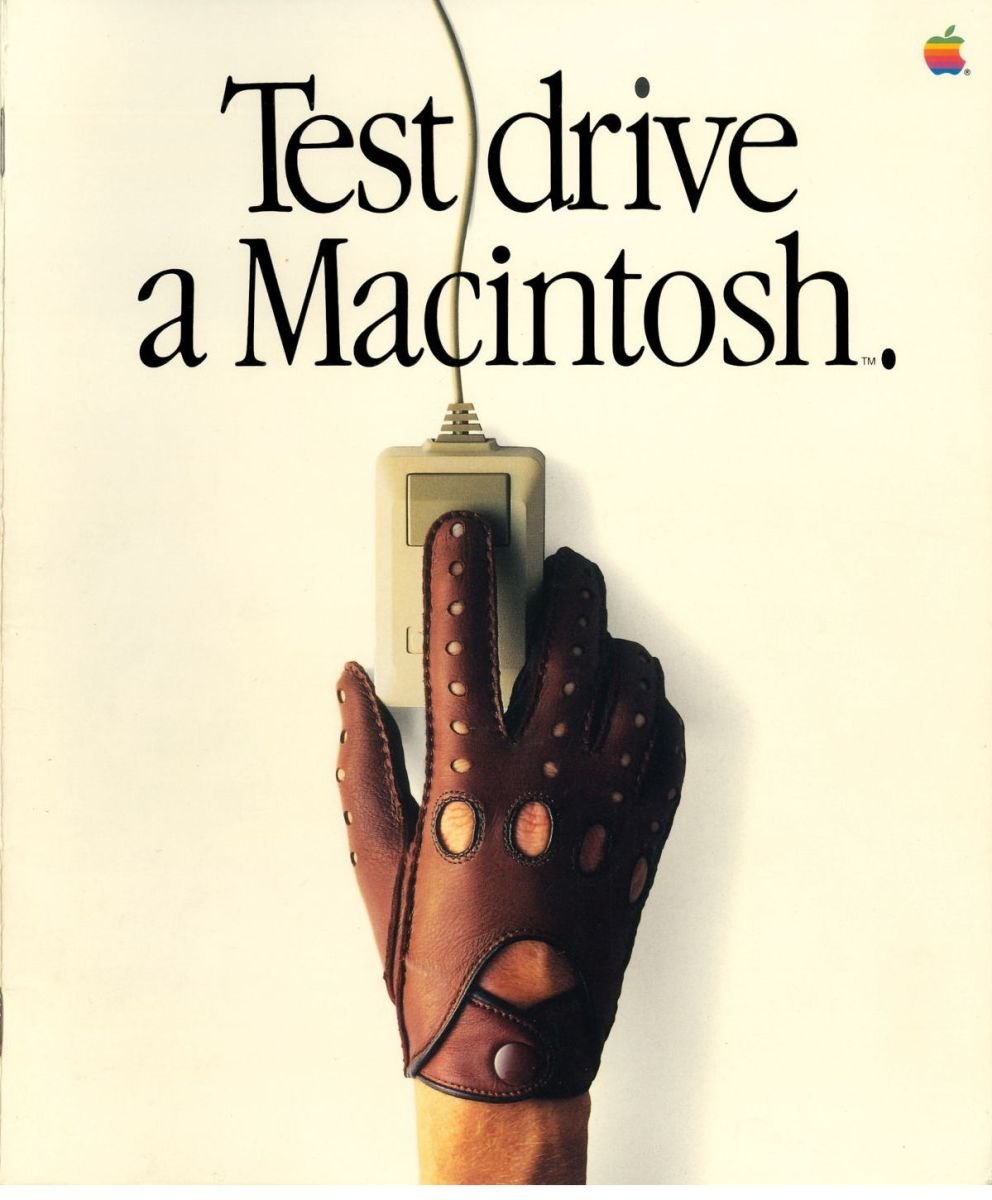
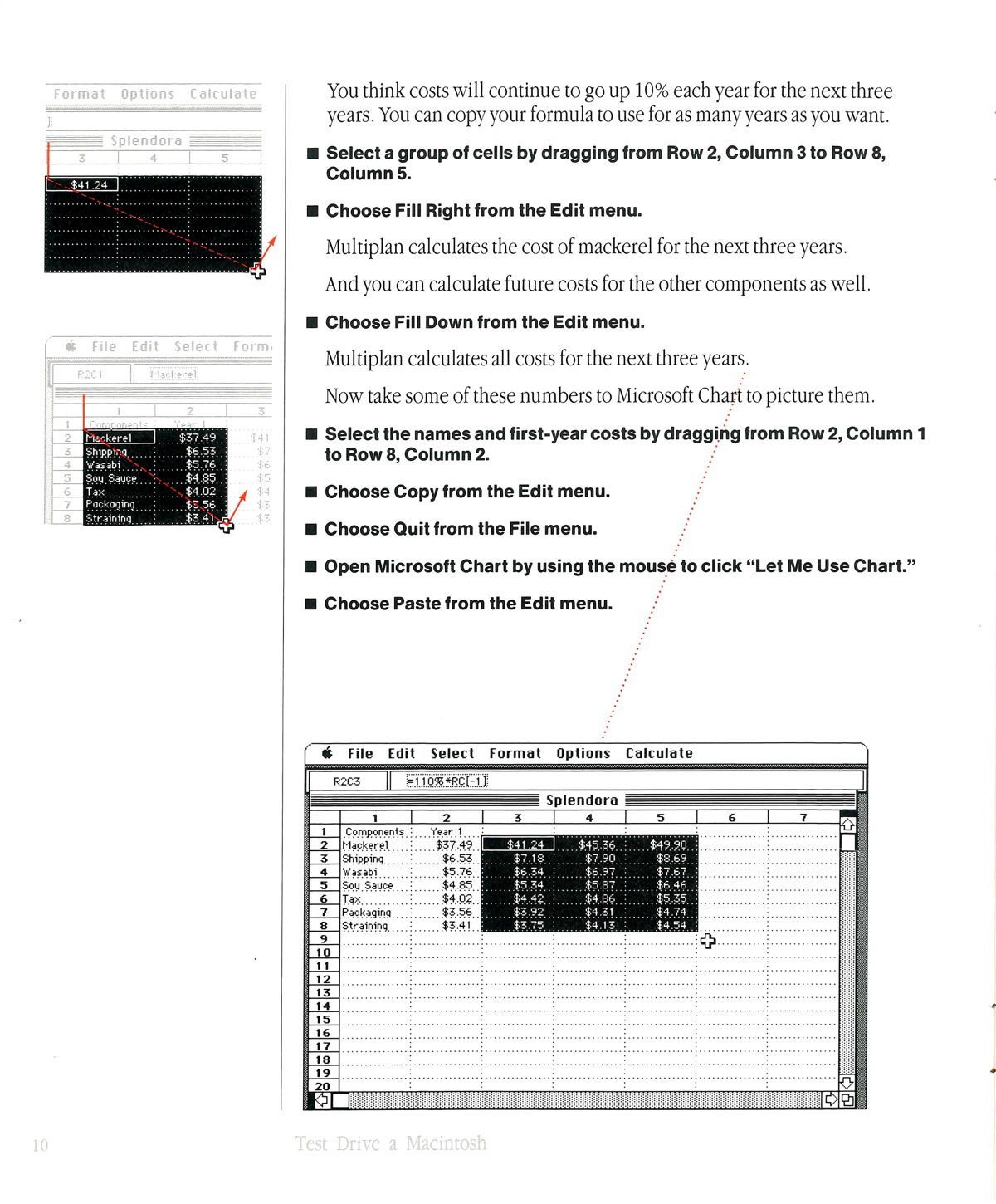
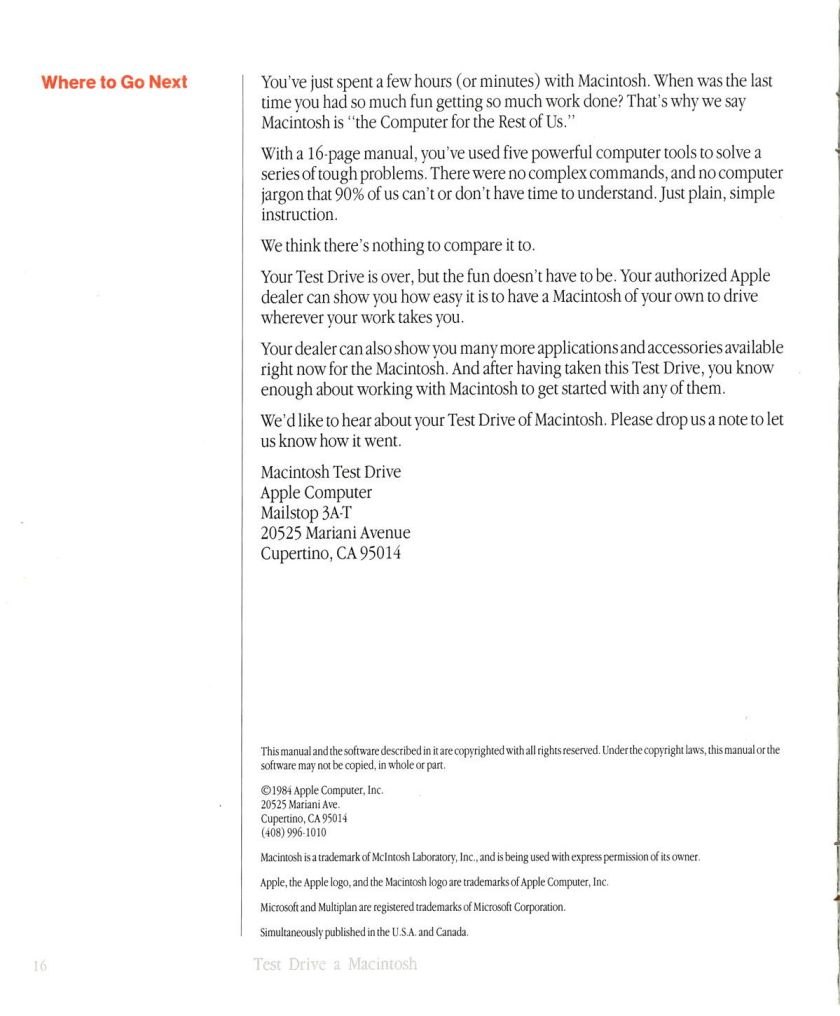
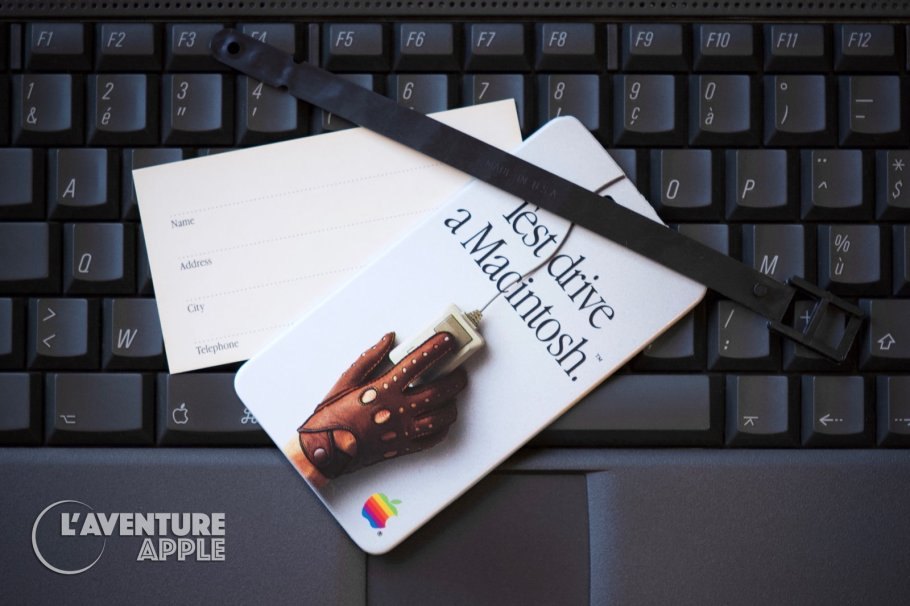
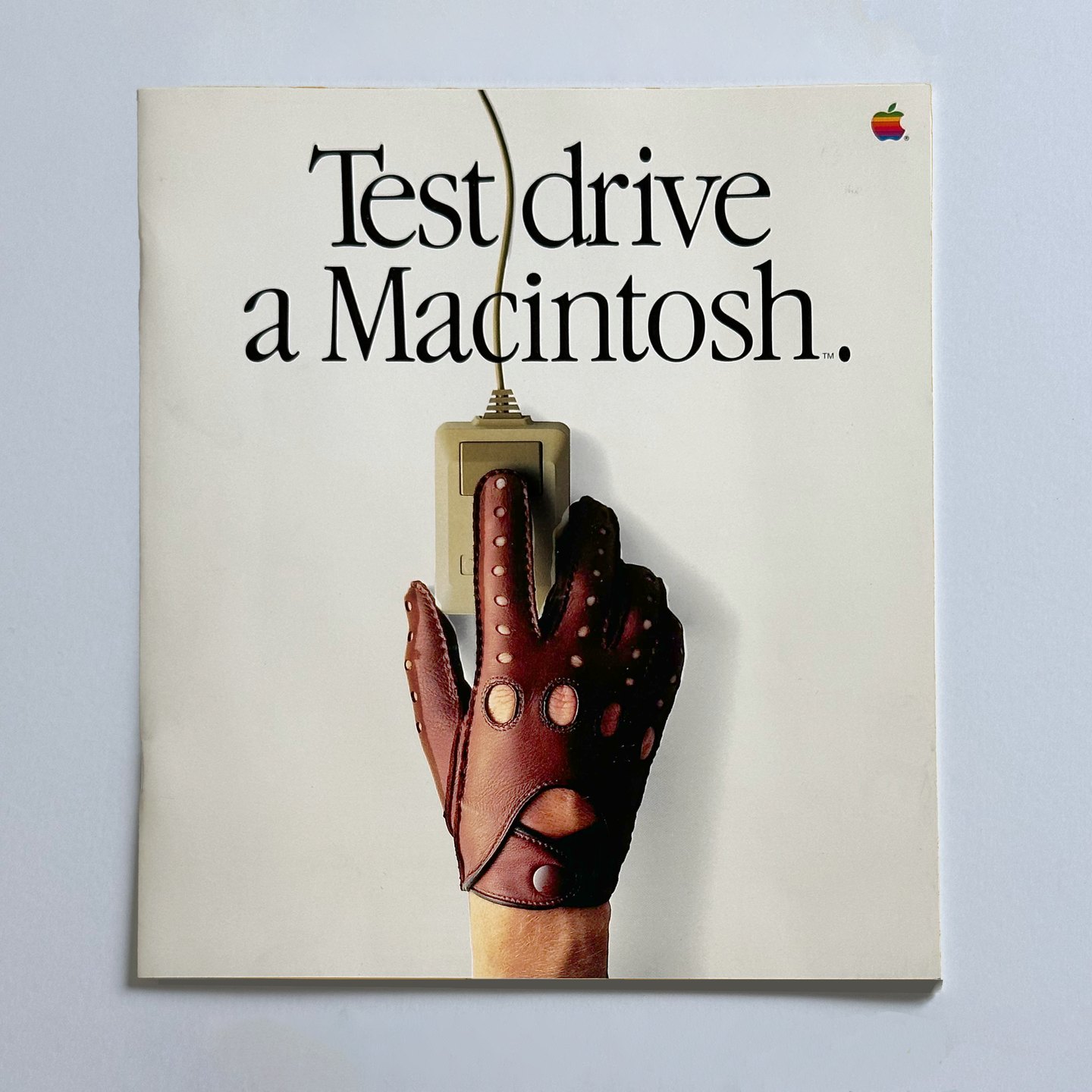
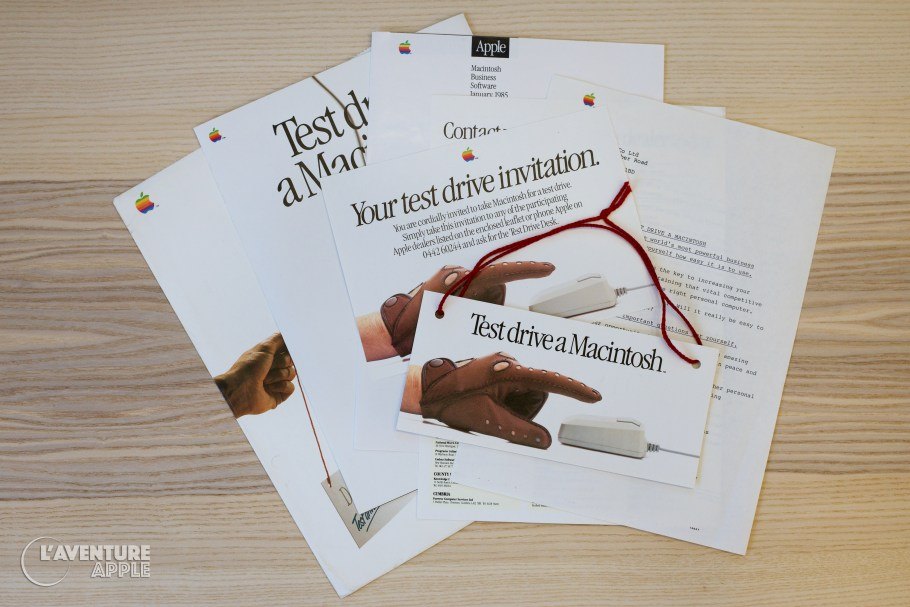
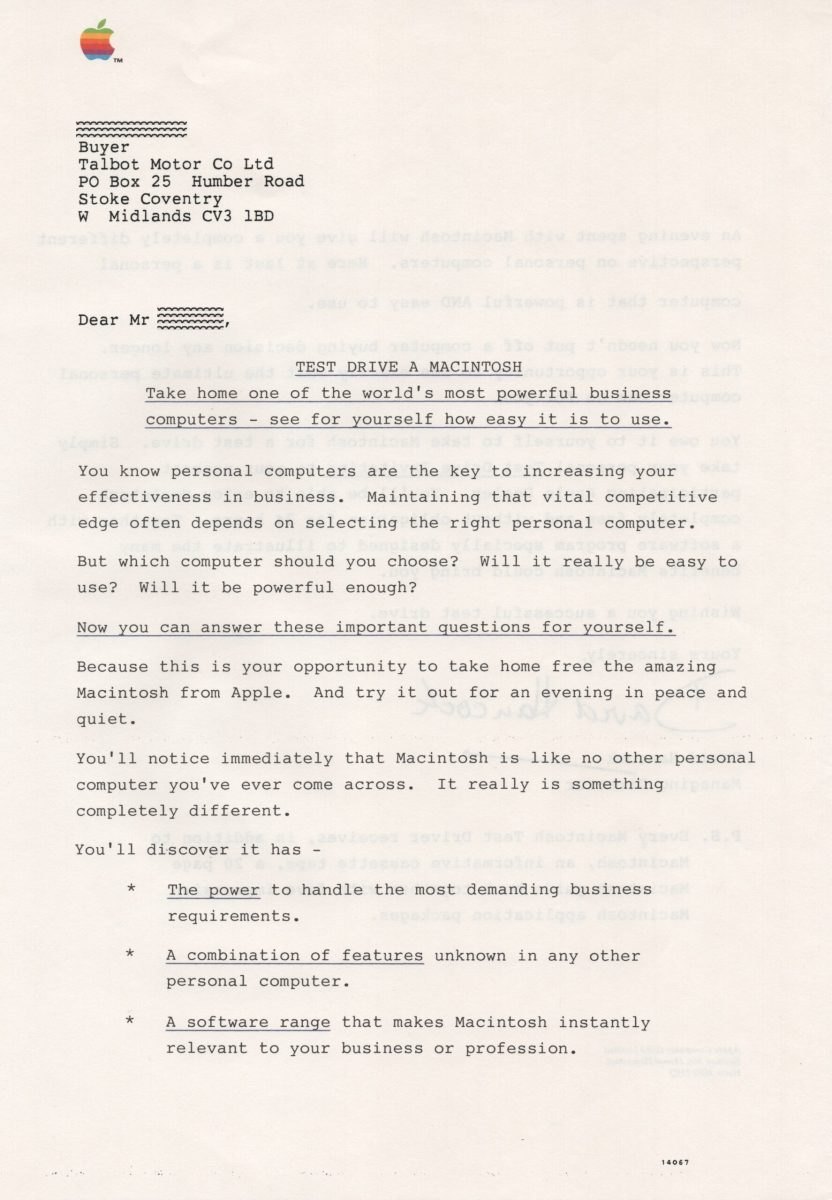
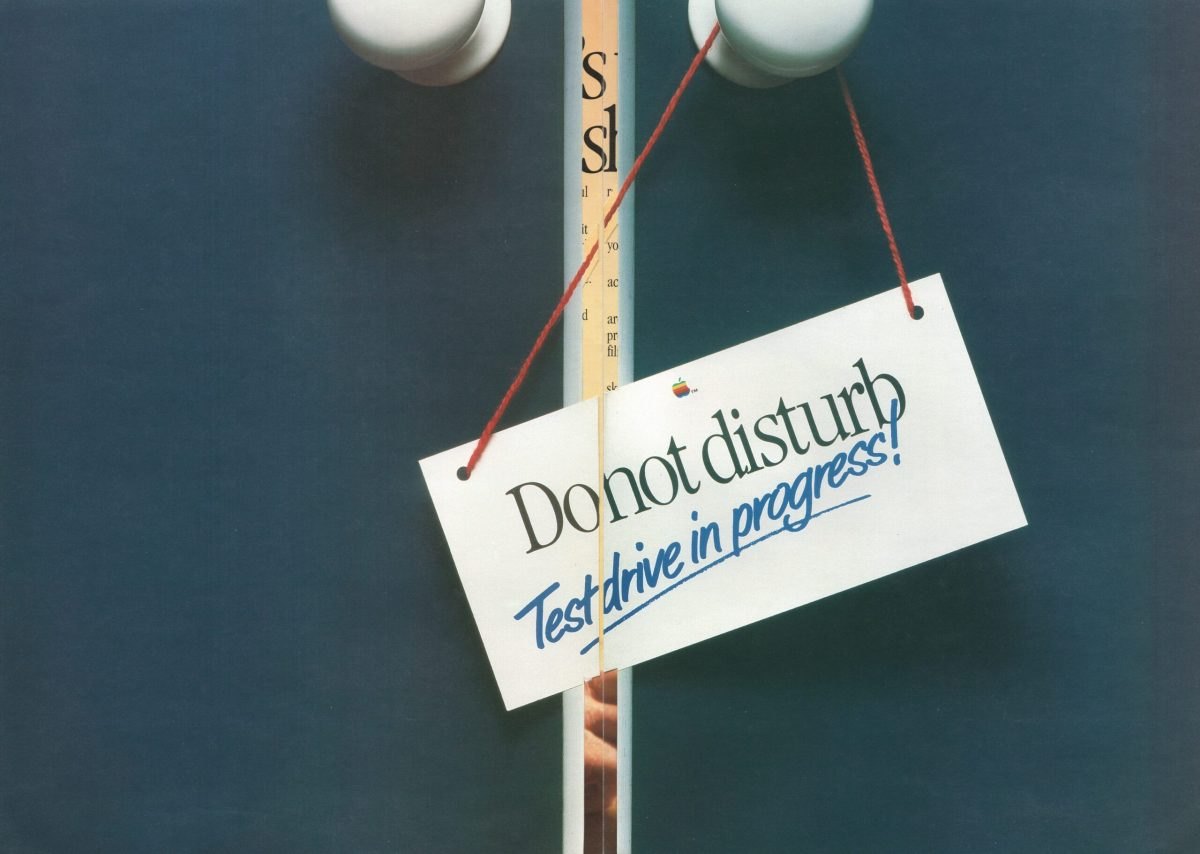
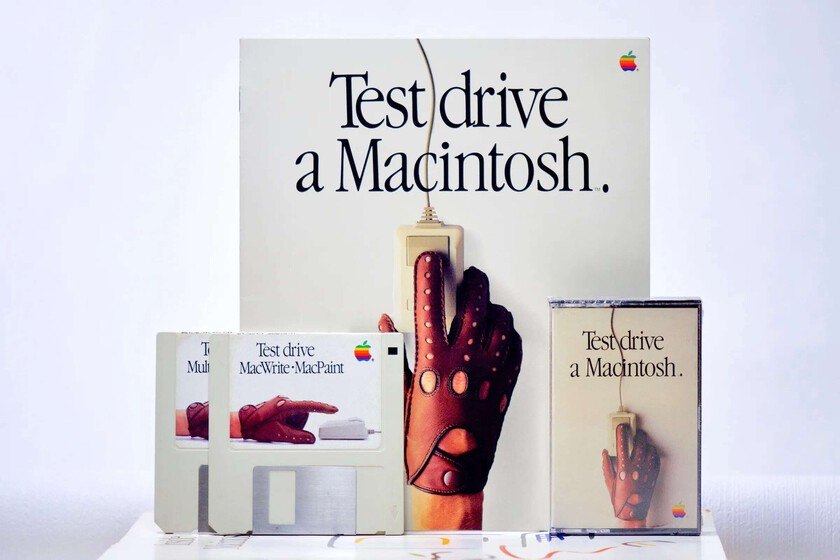
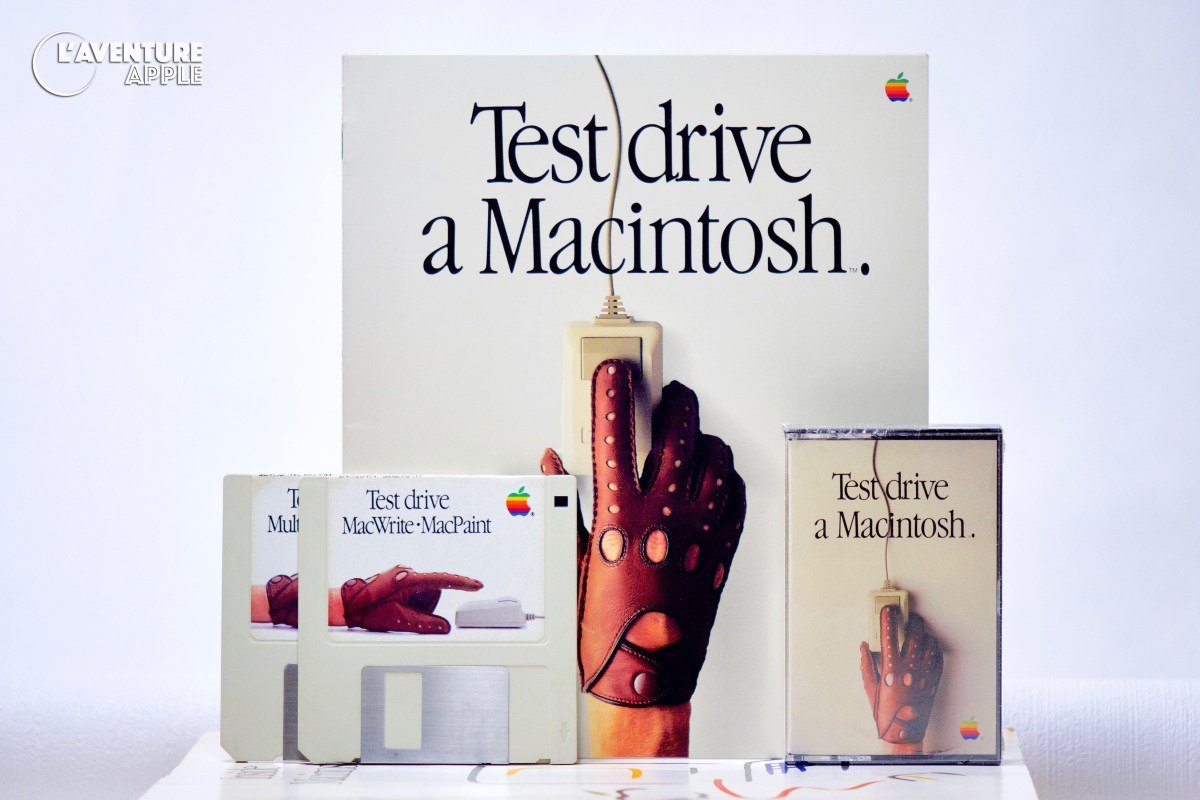
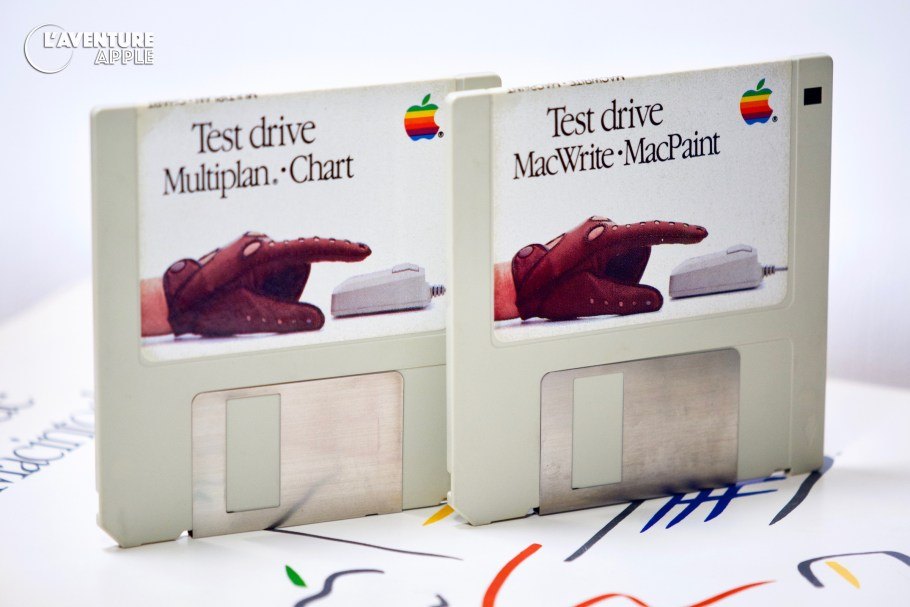
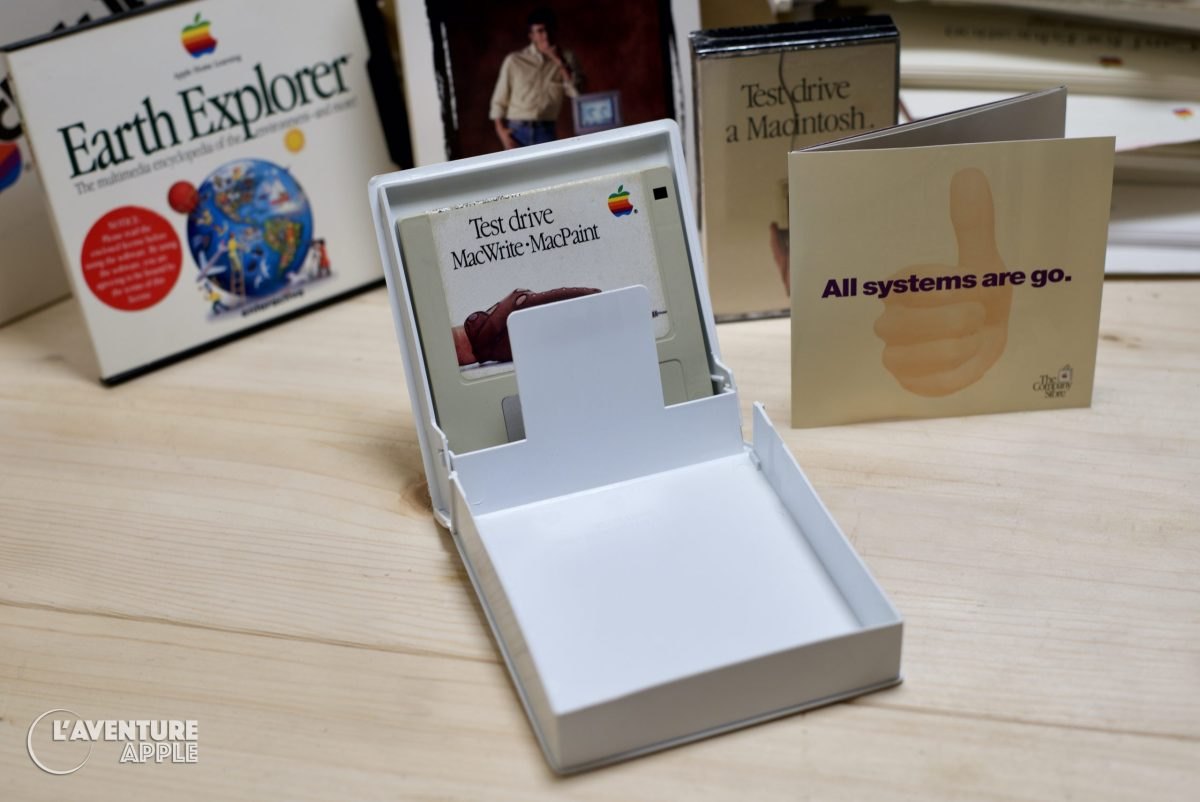
On 8 November 1984 Apple launched Test Drive a Macintosh. The offer was simple: walk into a participating dealer, leave a credit card and fill in a form, and take a Macintosh home for 24 hours, free, with no obligation to buy. You went home with a kit — a booklet, an audio cassette guide, demonstration floppy disks of Multiplan and Chart, and a carrying case — and a 16-page brochure that ended on the line the computer for the rest of us. The announcement ran as the fold-out final page of the Newsweek buy.
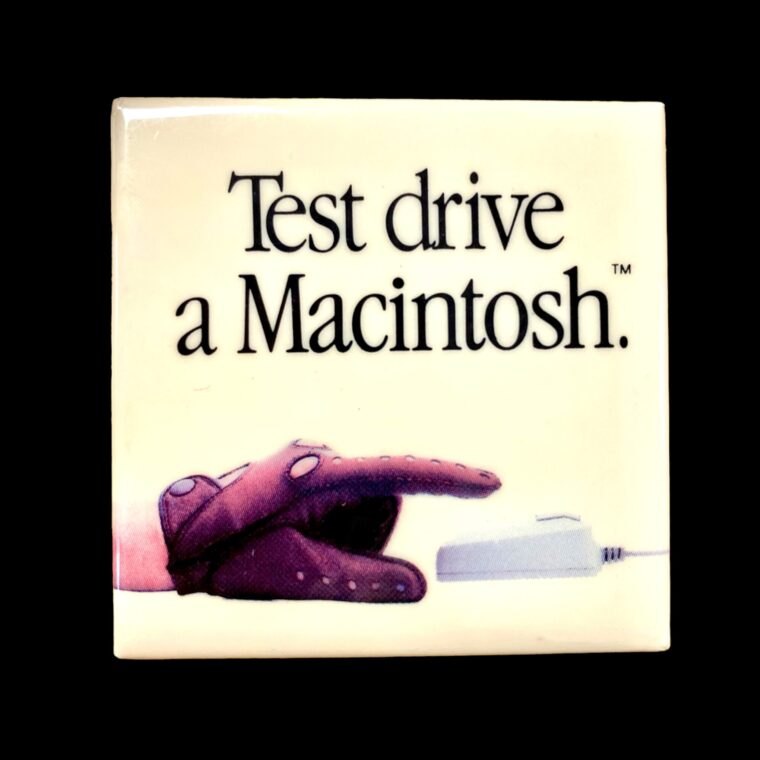
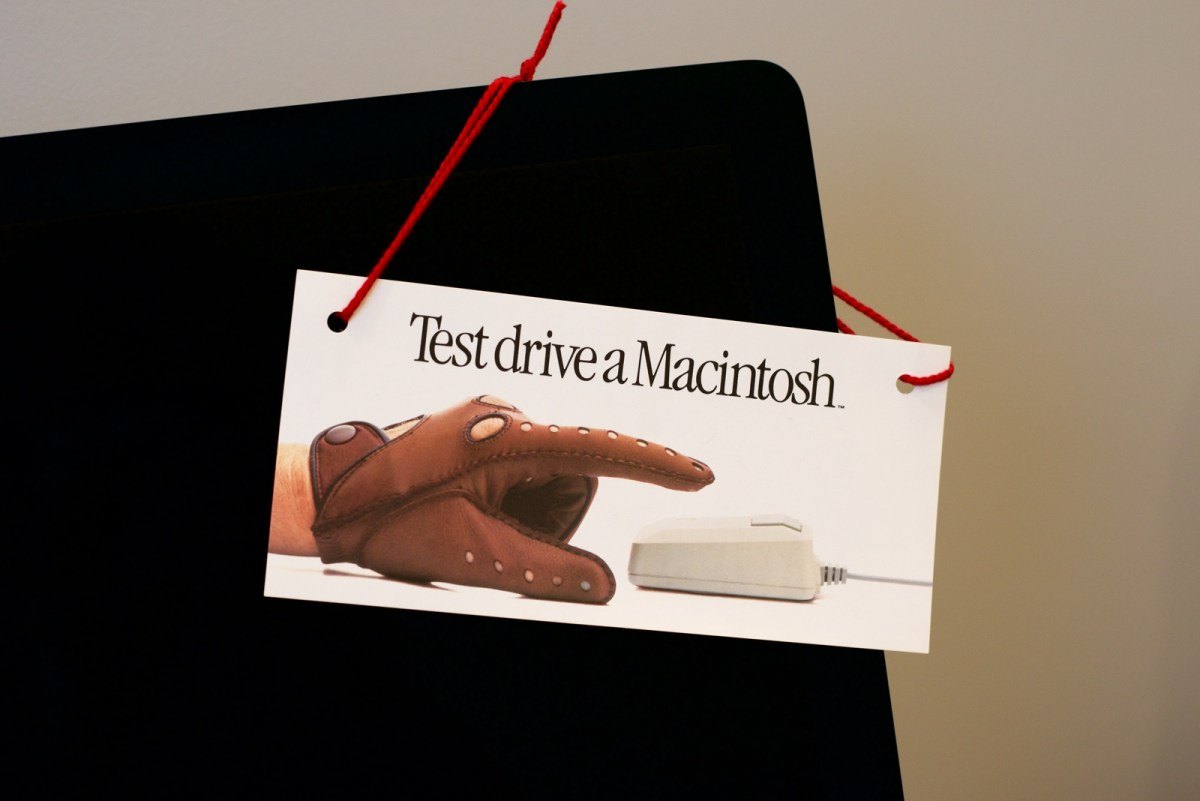
The naming is the part worth stealing. The borrowed ritual did two jobs at once: it told the customer exactly what to do, and it gave them permission to try a computer without confessing in a shop that they did not know how one worked. The automotive register ran right through the work — the dealer poster showed a hand in a racing glove reaching for the mouse button, and the television spot Unveiling hid the machine under a dust cover shaped like a sports car.
About 200,000 people took a Macintosh home. Almost none of them bought one. The trial converted the doubt and left the price untouched, and 2,495 dollars was still 2,495 dollars on the Monday morning. Dealers carried the cost: machines that were already in short supply went out on loan instead of being sold to people holding cash, the paperwork was theirs, and units came back marked and no longer sellable as new. Apple never ran it in that form again.
The work.
Film
Around the work
Same shape of problem.
More from Apple.
Every Applecampaign →Two hundred thousand people took a Macintosh home for the night. Almost none of them kept it.
Back to the archive →