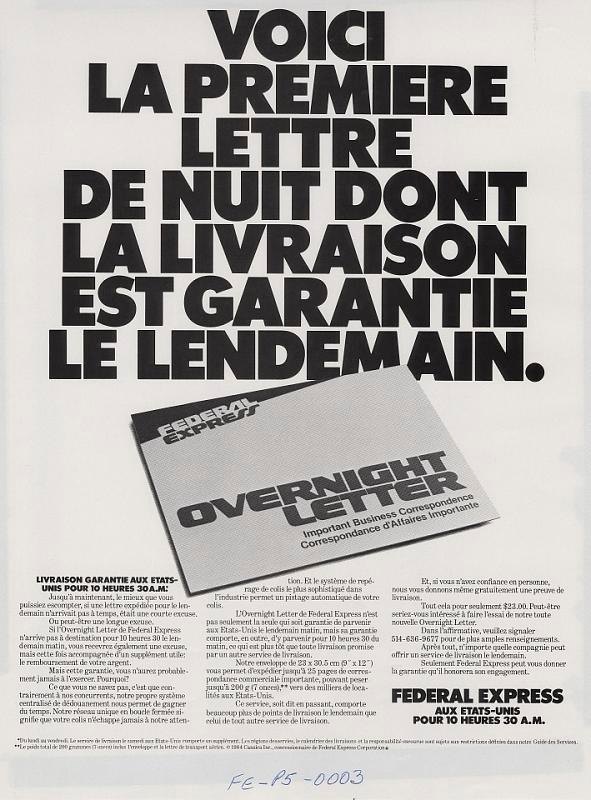
Federal Express · Ally & Gargano
Fast-Paced World
An overnight courier proved its promise of speed by making the viewer struggle to keep up, and a business service became a phrase people repeated at home.
The era.
Federal Express was founded in June 1971 by Fred Smith and began overnight flights on 17 April 1973, with fourteen Dassault Falcon 20 jets linking twenty-five American cities. The first night it carried 186 packages. Smith moved the company to Memphis, which became its hub, and the larger Memphis Superhub opened in 1981.
The agency was Ally & Gargano of New York, founded in 1962 by Carl Ally, Amil Gargano and Jim Durfee. It had worked with Federal Express since 1973, through the company's early years of losses. Smith later said that without Ally & Gargano, Federal Express would probably not exist.
By 1981 the company had a line, "When it absolutely, positively has to be there overnight", and a service that offices relied on. Outside those offices it was still little known. Overnight delivery was something one business bought from another, out of sight.
The culture.
American television commercials in the early 1980s were mostly polished and familiar. Actors with trained voices held products to the camera, and a jingle carried the brand name. Three networks still held most of the prime-time audience, so a commercial that broke the pattern could be seen by most of the country.
Joe Sedelmaier, born in Orrville, Ohio, in 1933, had been an art director at Young & Rubicam and J. Walter Thompson before directing commercials from Chicago. He cast offbeat faces in place of polished actors and let scenes play dry. Critics later compared his effect on commercials to Preston Sturges's effect on Hollywood comedy.
John Moschitta Jr., born in New York in 1954, could speak clearly at a speed that sounded impossible. In 1981 he appeared on ABC's That's Incredible! reciting lyrics from The Music Man at full pace. Two people at Ally & Gargano, Patrick Kelly and Michael Tesch, saw it.
The problem.
Make people feel the speed of a service they never see.
Federal Express sold speed, and speed is hard to show. A jet in the sky or a van at a door looks the same for every courier. Emery, Purolator and the Postal Service's Express Mail were all claiming fast delivery too.
By 1981 the company had a service offices relied on and a line, "When it absolutely, positively has to be there overnight." Outside those offices it was still little known. The buyer was a person at a desk who needed something across the country by morning and did not yet know whom to call. The line existed. The brand needed a picture of it that people would remember and repeat.
Ally & Gargano had handled Federal Express since 1973 and already had the line about overnight delivery. In 1981 Patrick Kelly and Mike Tesch saw John Moschitta Jr. talking at speed on That's Incredible! and hired him for a Federal Express commercial.
The solution.
Make the viewer hear the speed. Then say the promise slowly.
Patrick Kelly and Mike Tesch built the sixty seconds around Moschitta as a fast-talking executive, Jim Spleen, firing off orders and phone calls at a pace the ear can only just follow. Sedelmaier shot it flat and dry, with ordinary office faces reacting a beat late. Then the voice slows, and the line arrives at normal speed: when it absolutely, positively has to be there overnight. The viewer has spent a minute keeping up, so the claim lands as something already felt. The spot won six Clio Awards, including best male performance for Moschitta, who became known as "Motormouth".
The work.
Film
Same shape of problem.
Two people at the agency saw a man on That's Incredible! who could talk at 586 words a minute.
Back to the archive →