The era.
ESPN went on air from Bristol, Connecticut, on 7 September 1979. To fill its hours it showed whatever it could get: slow-pitch softball, kick boxing, Australian Rules football, Irish hurling and tractor pulls. It lost millions in its first years, and Sports Illustrated called it one of the strangest creations in the history of mass communications.
The business changed in the 1980s. In 1983 ESPN began charging cable operators for carriage instead of paying them, and by the end of that year it reached 28.5 million homes, the largest audience in cable. ABC bought the network in 1984, and Capital Cities bought ABC in 1986.
Then came the major leagues. ESPN carried its first NFL games in 1987, with a Sunday-night package that began in the regular season on 8 November. In January 1989 it signed a four-year, $400 million contract with Major League Baseball for 175 games a season from 1990. By 1990 the Wall Street Journal ranked it the largest cable network, with 54.8 million subscribers.
The culture.
Major-league rights had become very expensive. ESPN's baseball contract alone cost $400 million over four years, a network-sized fee that could only be paid for with network-sized advertising rates.
The trade press still saw the old ESPN. When Lois's agency took the account, an Adweek announcement joked that Lois would now become familiar with aerobics and demolition derbies. To media buyers the channel was where the strange sports were, and they bought it at a discount.
The athletes who could change that impression were expensive too. An ESPN executive told Lois that not one of the players he wanted would cross the street for less than $50,000.
The problem.
ESPN had bought the major leagues, and advertisers still priced it like the network of tractor pulls.
ESPN's programming had changed faster than its reputation. In its first years it filled airtime with slow-pitch softball, kick boxing and tractor pulls. By 1990 it carried the NFL and Major League Baseball, under a four-year baseball contract worth $400 million. Advertisers and media buyers still remembered the early schedule and treated the network as second-rate.
Lois says ESPN had sold its major sports at discounted rates for a decade. Network-sized rights fees could only be paid for with network-sized advertising rates. The baseball deal made the gap expensive, and ESPN eventually lost more than $200 million on it. The network needed viewers and buyers alike to put it in the same class as ABC, CBS and NBC.
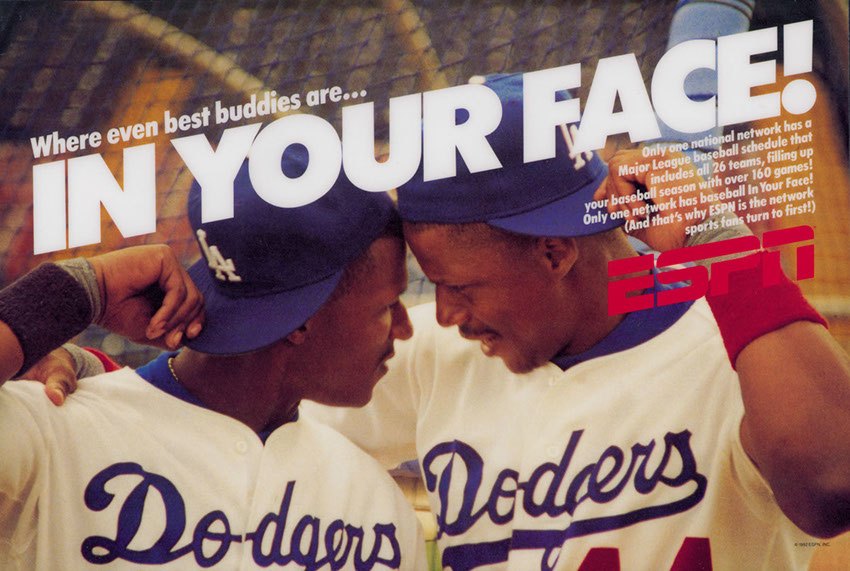
Lois/USA's appointment to ESPN was announced in Adweek around 1990. Lois says he pushed ESPN's management to let him make an in-your-face campaign with the biggest athletes in the sports the network now carried.
The solution.
Put the stars of the leagues ESPN now owned on screen, confronting the viewer, and let their faces carry the network's new rank.
Lois cast the biggest names in the sports ESPN carried and filmed them in confrontational, in-your-face spots. The roster included Roger Clemens, Darryl Strawberry, Bobby Bonilla and Eric Davis from baseball; Dan Marino, John Elway, Jim Kelly, Boomer Esiason, Warren Moon, Thurman Thomas, Andre Reed, Bruce Smith, Richard Dent, Ronnie Lott, Howie Long and Marcus Allen from football; Greg Norman and Gabriela Sabatini; and the coaches Mike Ditka, Joe Paterno and Rick Pitino. Despite the executive's warning, Lois says, they appeared for modest fees. In his account ESPN then sold out its baseball, NFL and college basketball inventory, and a tracking study ranked it ahead of ABC, CBS and NBC for sports. An ESPN executive called the campaign a Harvard Business School case study in turning around a company's image.
The work.
Film
Same shape of problem.
An executive warned that none of the athletes would cross the street for less than $50,000.
Back to the archive →