Xerox · Needham, Harper & Steers
Brother Dominic
A ninety-thousand-dollar production duplicator sold to print-shop managers by measuring it against a medieval scribe, with the claim spoken by a sceptic rather than the brand.
The era.
Office copying was barely fifteen years old as an everyday act. Before the Xerox 914 arrived in 1959, Americans made somewhere around twenty million copies a year; by 1966 Xerox machines alone had produced fourteen billion. Xerox had expected a customer to make about two thousand copies a month and found them making ten thousand, sometimes a hundred thousand. The routing slip, one document passed from desk to desk, died in those years and was replaced by a copy for everybody.
The machine also changed what paper was for. Office workers copied recipes, tax returns, jokes, chain letters and fake memos; Daniel Ellsberg copied the Pentagon Papers; by the end of the 1970s the copier was the printing press of anyone who did not own one. The historian David Owen's summary of what it did to meetings still holds: a huge pile of documents that nobody has read. Kinko's opened in 1970 with a single machine in Isla Vista, California.
Xerox's own machines were getting faster and heavier. The 6500 colour copier came in 1973, and the 9200 Duplicating System, announced around 1974, ran a hundred and twenty copies a minute, weighed close to two and a half thousand pounds and occupied the better part of a small room. The 1970s added collating, double-sided copying and stapling. The copier had stopped being an office convenience and had started competing with print.
The culture.
The people who actually operated these machines were clerical staff, and the 9200 was sold into a world of in-plant print rooms with their own foremen, their own presses and their own pride. A print-shop manager who had spent a career with ink, water and a large press was being asked to accept a dry machine that made his craft look like a bottleneck. Xerox salesmen of the period remember the resentment directly.
On television, the Super Bowl was turning from a large rating into an event in its own right. This campaign is one of the earliest commercials people remember from a Super Bowl rather than from a programme, which is itself the evidence of the change: the Hagley Museum and Library calls it perhaps the first commercial to travel the way a story travels, and the Entertainment and Sports Programming Network put it fourth on its list of the best Super Bowl commercials ever made in 2006.
The monk was a joke the whole audience already knew the setup to. A scriptorium is the one universally legible picture of copying before machines: a man reproducing a page by hand, beautifully and slowly. Jack Eagle, who played Brother Dominic, came out of big-band trumpet and the Catskills comedy circuit, and the performance belongs to the gentle character comedy then filling American television rather than to advertising acting.
The problem.
Xerox had to persuade print-shop managers to retire a printing press, at the moment its patents stopped keeping competitors out.
Xerox held more than two thousand copier patents and close to ninety-five per cent of the plain-paper copier market in 1972, and it refused to license any of it. The Federal Trade Commission filed an antitrust complaint that year, and the consent decree Xerox signed in 1975 forced it to license every copier patent it held, with the first three licences to each firm royalty-free and later royalties capped at 1.5 per cent of the licensee's revenue. The moat was drained by agreement.
Competitors were already inside. International Business Machines announced its first copier on 21 April 1970 and the Copier II in 1972, and Xerox was suing it within weeks; Eastman Kodak entered in 1975 with the Ektaprint 100 Copier-Duplicator and went straight for the large, high-volume accounts Xerox depended on. Canon, Konica, Minolta, Ricoh and Sharp came in underneath with smaller, cheaper machines, several of them more reliable than Xerox's, which averaged three breakdowns a month. Xerox's worldwide share of plain-paper copying fell from eighty-five per cent in 1974 to forty per cent by 1985.
The 9200 was Xerox's answer at the top of the range, and it created its own selling problem. At a hundred and twenty copies a minute and roughly ninety thousand dollars, it was not sold against other copiers but against offset printing, which meant the buyer was an in-plant print shop that already owned a press and knew how to use it. Xerox had almost no standing with those buyers.
So the brief was not to explain a copier to an office. It was to make a conservative technical buyer, in the middle of a capital decision, accept that a dry machine could replace ink and water, and to do it in sixty seconds, to an audience that had never set foot in a print room.
Xerox was already a Needham, Harper and Steers client when the 9200 arrived, and Allen Kay's own account is that his partner Lois Korey brought him onto the account in 1971 with the words that it would be fun. No source reached in this research names the Xerox marketing or advertising person who set the brief, so the client side of this record is incomplete. What is clear from the sales story is the task: the 9200 had almost no acceptance among in-plant print shops, which worked with ink, water and large presses, and the machine had to be made credible to them.
The solution.
Measure the machine against the thing it replaced five hundred years ago, and let a sceptic say the line instead of the brand.
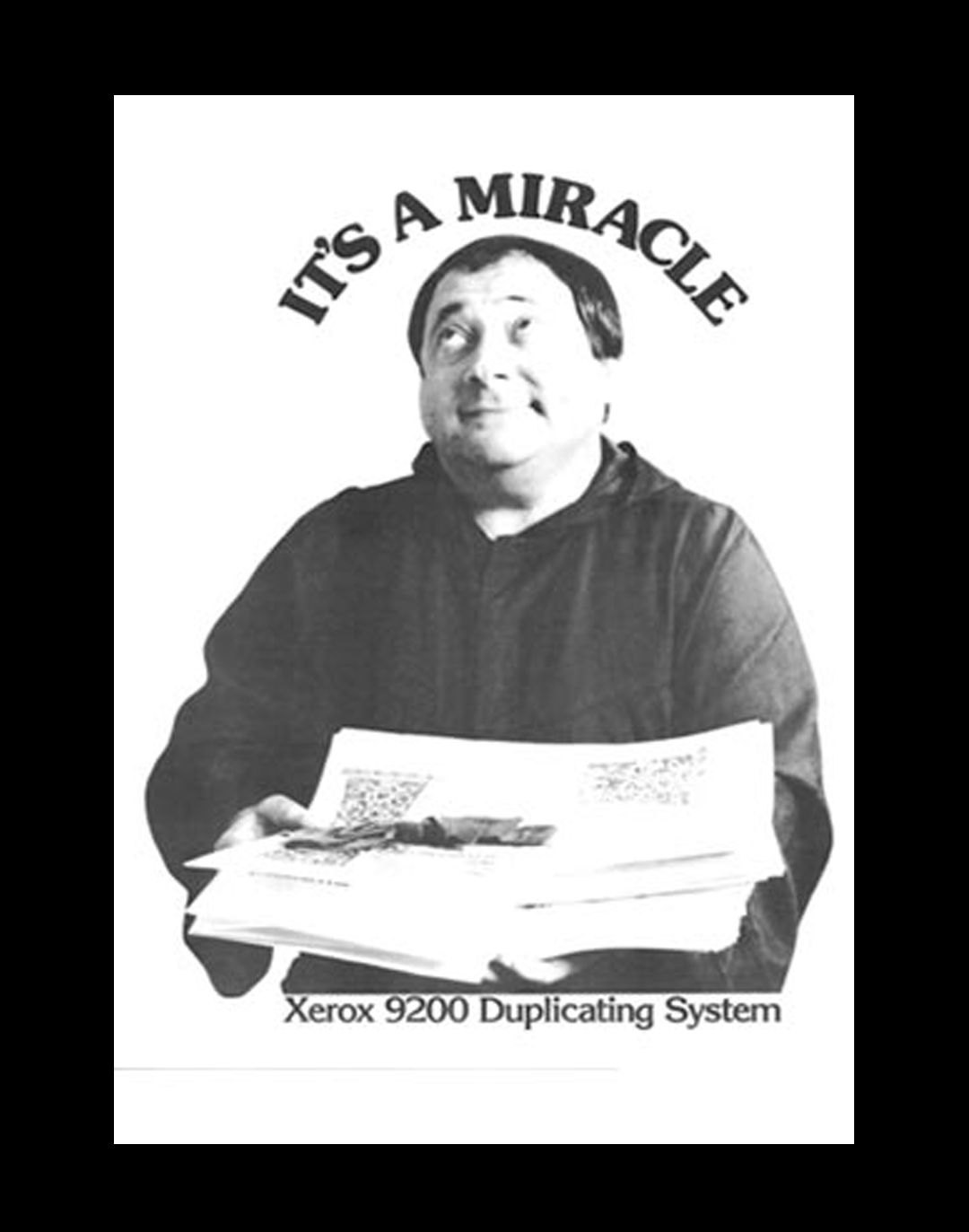
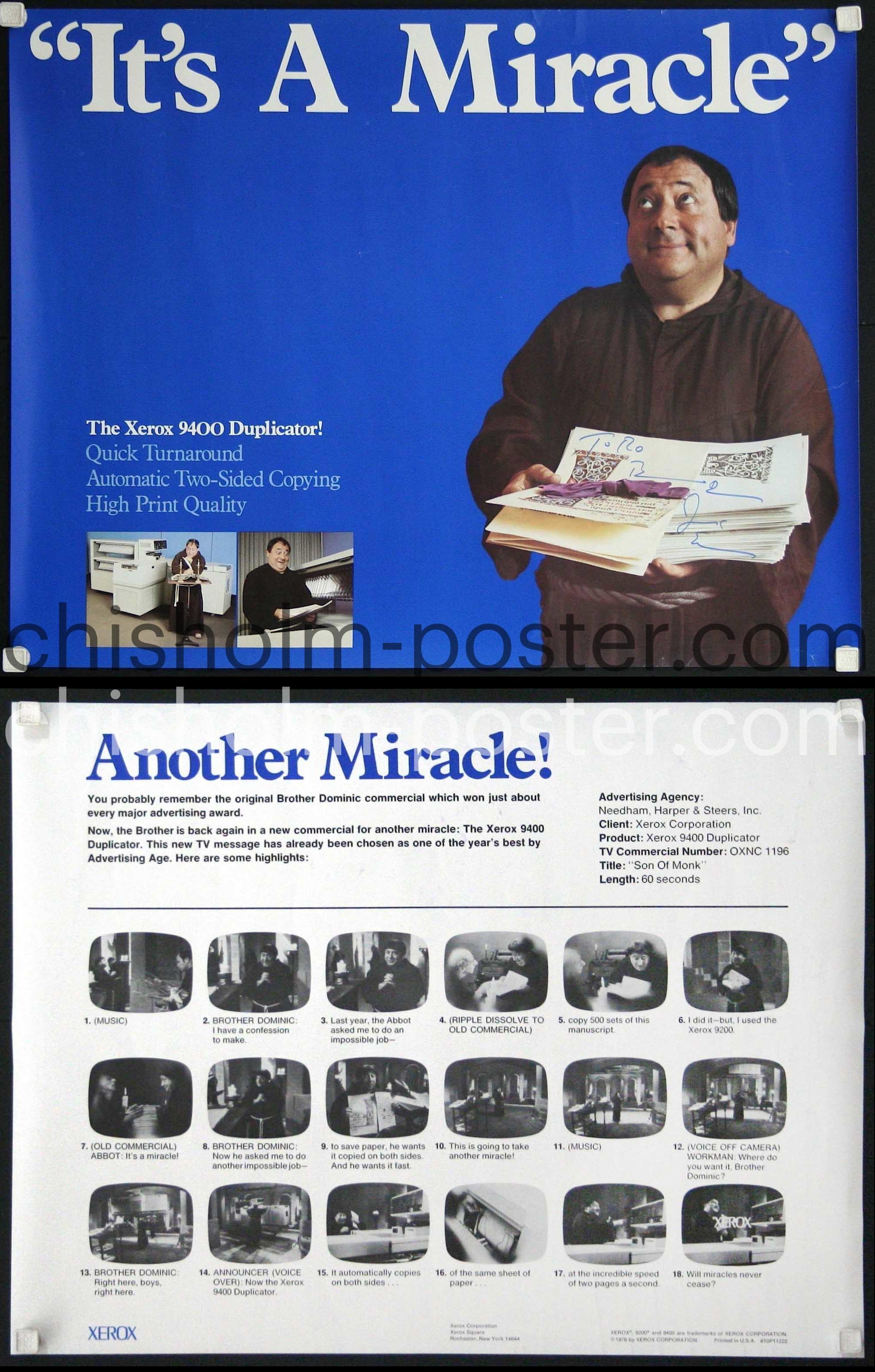
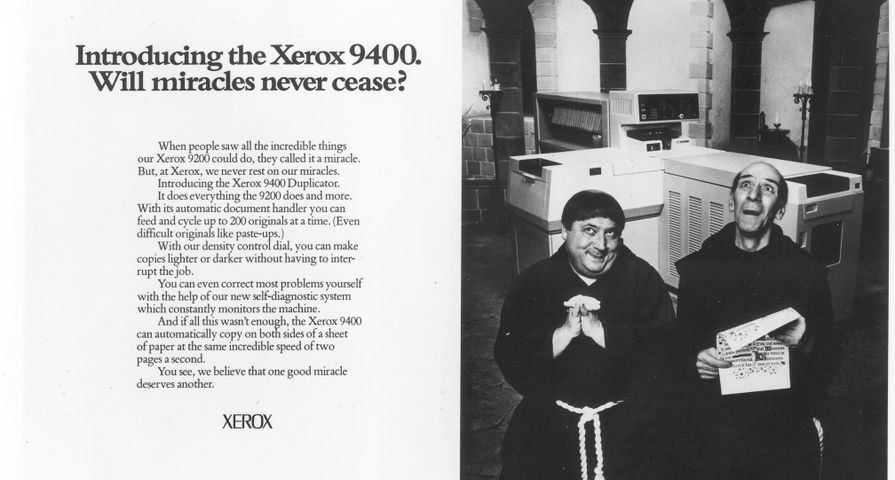
The agency refused the comparison the category offered. Rather than setting the 9200 against a press or against a rival copier, it set the machine against a monk copying an illuminated manuscript by hand. Brother Dominic is handed a manuscript, disappears, returns with five hundred copies, and the Abbott says it is a miracle. No speed figure is argued and no specification is read out; the audience does the arithmetic itself, and the gap between a scribe and seven thousand impressions an hour is not something anyone can dispute.
The claim is also never made by Xerox. The brand says nothing about the machine being remarkable. A sceptical superior says it, as a reaction, as the punchline. That costs nothing and it is the whole trick.
The second decision was to build a character who could leave the film. Jack Eagle, cast after an audition, went on to play Brother Dominic in person under a three-year contract: he made four or five customer calls a day with local Xerox representatives in major markets, appeared at the In-Plant Manager's Association show in Dallas, and in 1979 walked into the National Association of Manufacturers headquarters in Washington carrying his five hundred copies. His own account of what that did is the useful part: the costume got sales representatives in front of executives they could not otherwise reach. A character can work as a lift inside the client's own organisation chart.
Six Brother Dominic films were shot between 1975 and 1982, for the 9200, the 9400, copy quality, simplicity and the Xerox computer. The campaign appeared on at least two consecutive Super Bowls, ran in trade press and on dealer posters, and is in the Clio Awards Hall of Fame. By 1980 an Associated Press headline was comparing the monk to Colonel Sanders.
The work.
Film
Same shape of problem.
To sell a copier to a print shop, Xerox compared it with a man copying a book by hand.
Back to the archive →