They Left Us to Kill the Dogs
A charity that had always asked for sympathy accused the Government instead, and came within thirteen votes of changing the law.
The era.
The dog licence cost 37½ pence and about half of Britain's dog owners had never bought one. In 1988 the Government abolished it under the Local Government Act and declined to put a registration scheme in its place. The RSPCA wanted compulsory national registration, at a fee of around fifteen pounds a year, and said the stray problem was growing out of control.
The charity was the country's best-liked animal body and the one that did the unglamorous work. Its own records put its destructions at 61,615 dogs in 1987, and it argued that across the RSPCA, the police and other bodies the figure was about a thousand a day. The claim was contested in Parliament and in the press, and the charity's communications director, Gavin Grant, had arrived in 1988 from a campaigning background and intended to campaign.
Abbott Mead Vickers had been the RSPCA's agency through the late 1980s, and David Abbott and Ron Brown, who had made the Volvo and Economist work, were the team on it.
The culture.
Britain in 1989 was a country of dog lovers that did not look at what happened to unwanted dogs. The RSPCA's public image was the inspector in the van and the puppy waiting for a new home, kindly and uncontroversial, and the gap between that image and the work in the back of the building was the charity's problem and its opportunity.
Charity advertising still asked. It showed the animal in need and the coupon beneath. The idea that a charity might attack a Government in a forty-eight-sheet poster, and name the policy in the headline, was new enough to be a news story in itself.
The Thatcher Government had a Commons majority of more than a hundred, and a backbench rebellion was the only route to a law it did not want. Pressure on individual MPs from their own constituents was the lever, and the press and poster campaign was built to pull it.
The problem.
The public liked the RSPCA and had no idea how many dogs it was putting down, and a Government with a large majority had no reason to listen.
The RSPCA's objective was not money. The Institute of Practitioners in Advertising record of the campaign states it plainly: to raise public support and understanding of the problem, and to force a change in the law. Research before the campaign found the public sympathetic to the charity but unaware of the scale of the stray problem, which meant sympathy would not turn into letters to MPs on its own.
The charity also had a credibility problem of its own making. Its thousand-a-day figure was an estimate for every body that destroyed dogs, not its own count, and critics said so. Whatever the advertising did, it had to be strong enough to be noticed by a Government that could ignore it, and sound enough to survive being argued with.
After the dog licence was abolished in 1988 and the Government refused a registration scheme, the RSPCA set out to force a change in the law. Gavin Grant, its director of communications from 1988, is the client figure named in the press and pictured with the agency; no source states in terms that he wrote the brief. Abbott Mead Vickers, already the charity's agency, answered with the 1989 press and poster campaign.
The solution.
Make the consequence of the policy visible in one photograph, put the blame in the headline, and ask readers to write to their MP.
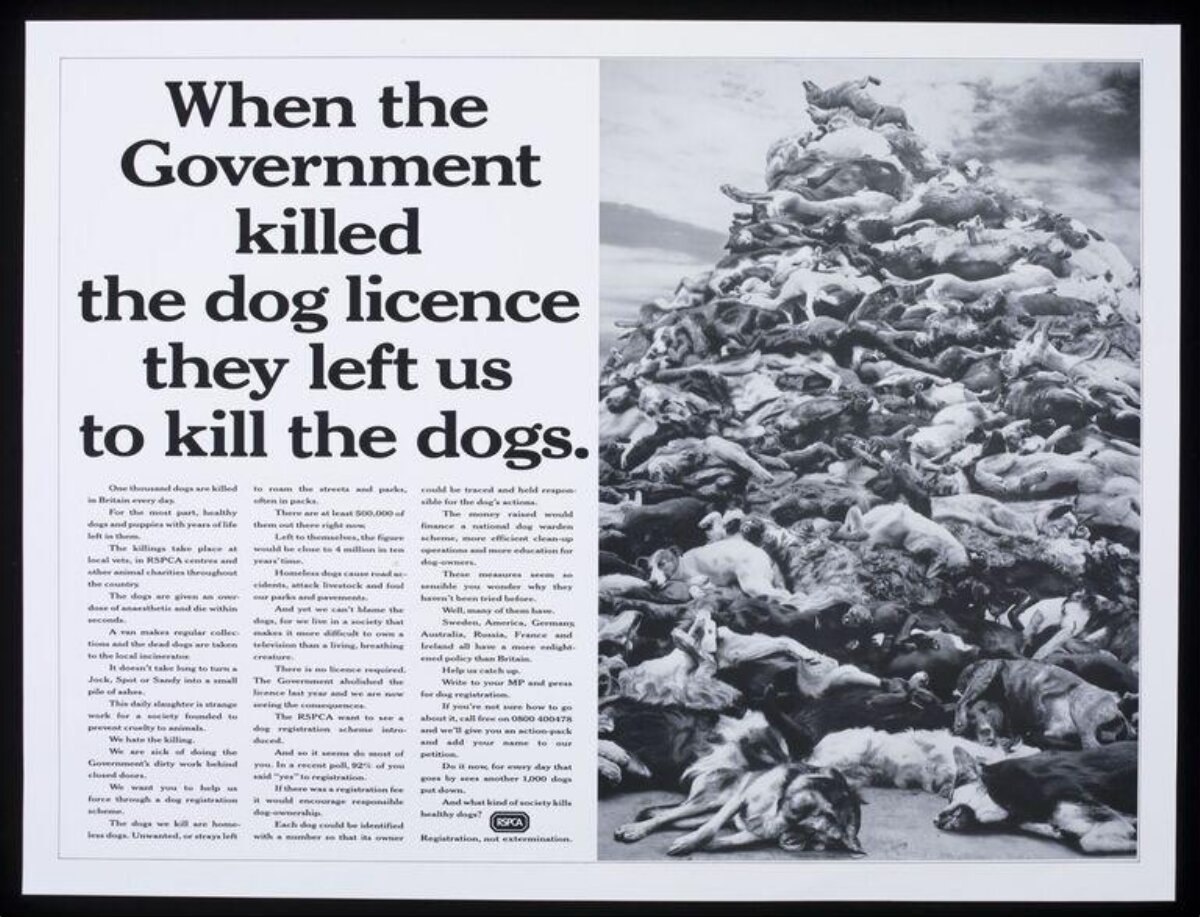
Abbott and Brown made a poster of the thing nobody looked at. Derek Seagrim's black-and-white photograph showed a pile of dead dogs. The headline read: When the Government killed the dog licence they left us to kill the dogs. The copy gave the thousand-a-day figure, blamed the abolition of the licence, asked readers to write to their MP and gave a telephone number. It ran as a double-page spread in the quality press from late January 1989 and as a forty-eight-sheet poster, one of them sited outside Crufts.
The form was the argument. A policy is abstract; a pile of bodies is not. By putting the Government in the headline and the RSPCA in the position of the reluctant executioner, the ad turned a charity that asked into a charity that accused, and it put the reader's own MP at the end of the sentence. A second phase kept the issue in front of the middle-market papers.
One insertion generated 4,690 telephone calls in a day. Post-campaign research showed very high awareness and better knowledge of the facts. In June 1989 Dame Janet Fookes's amendment to make registration compulsory was debated with MPs citing constituents' letters, and the Institute of Practitioners in Advertising record says it fell by only thirteen votes against a Government majority of more than a hundred. Later attempts in 1990 also failed narrowly. Registration never came; the Government legislated instead for collars, tags and council duties over strays. The poster went into the Victoria and Albert Museum, and the RSPCA, thirty-four years later, went back to the same agency.
The work.
Same shape of problem.
When the Government abolished the dog licence and refused to replace it, the RSPCA stopped asking for sympathy and showed the country what it was being left to do.
Back to the archive →