American Express · Ogilvy & Mather
Do You Know Me?
How a card you had to pay for answered the free bank cards: by selling recognition instead of credit.
The era.
The United States in the middle of the 1970s was not in the mood for luxury. The oil shock of late 1973 put queues outside filling stations, odd-and-even rationing on number plates and a fifty-five-mile-an-hour limit on the highways. The recession that ran from 1973 into 1975 was the deepest since the war. In Oregon that winter, photographers recorded stations hanging up Sorry signs for the last car in the line and businessmen hitchhiking to work.
The credit card arrived in American households during the same decade, and it arrived uninvited. BankAmericard began licensing to banks outside California in 1966, and that Christmas five Chicago banks posted five million cards to people who had not asked for them. In 1968 First National City Bank moved 1.3 million of its own cardholders into Master Charge in one step. Congress stopped the unsolicited mailings in 1970 and limited a cardholder's liability for a lost card; the Fair Credit Billing Act followed in 1974. By 1977 Citibank was putting direct mail into an estimated twenty-seven million homes.
American Express was a company built on moving money and people rather than on lending. Its Travelers Cheques and its overseas offices had been the business for most of a century. The card launched on 1 October 1958 as a charge card, settled in full each month, and George Waters spent the 1960s making it pay: he raised the annual fee and the merchant discount, cut off roughly a third of the card base for late payment, and passed Diners Club on charge volume in 1964. By 1978 there were nine and a half million card members.
The culture.
By the mid-1970s recognition had become a measurable asset. Television had spent twenty years turning a small number of faces into public property, and the talk show had fixed the form: a person in a chair, speaking straight to camera or to a host, listing what they had done. A guest segment was a short biography delivered by its own subject. That grammar was available to anyone who wanted to borrow it, and an advertisement that used it would not look like an advertisement.
The expense account was the other half of the picture. Business travel had become routine for a large white-collar class, and the hotels, airlines and restaurants that served it were the places where a card either worked or did not. American Express had spent decades building acceptance in exactly those places and offices abroad to back it up. That was a real advantage and an almost unphotographable one, which is the usual condition of a service business.
The campaign's own format eventually entered the culture it borrowed from. By 1984 a political magazine was running an anti-Mondale poster built on the same device, with the card re-lettered as a Taxpayers Express Card. Children's television parodied it. A form that is copied by people with nothing to sell has stopped being an advertisement and become a public joke that the advertiser owns.
The problem.
American Express had to persuade people to pay a yearly fee for a card the banks were posting out free.
The American Express Card was a charge card. The balance was settled in full every month, so there was no interest income; the money came from an annual fee paid by the cardholder and a discount paid by the merchant. Both sides had to be sold on paying for something, in a market where the alternative arrived unasked in the post. Through the late 1960s and into the 1970s the bank cards scaled at a speed a fee-paying card could not match.
By 1977 BankAmericard was becoming Visa, backed by an advertising budget of 8.15 million dollars and a promise of acceptance in more than a hundred and ten countries, and Citibank was mailing to an estimated twenty-seven million homes. American Express was still charging merchants a higher discount than its rivals and still asking the public for a fee. What it actually had - offices in foreign cities, Travelers Cheques, a hundred years of getting people out of trouble a long way from home - was the hardest kind of advantage to make anyone feel. Its own name was known and its card was not: a thing everybody had heard of and few could picture.
David Ogilvy was offered the American Express business in 1962 and the agency held it for more than two decades, until by the 1980s it had grown larger than General Foods, previously the agency's biggest account. George Waters, who had run the card since 1961 and was later given the honorific Father of the American Express Card, commissioned the tagline work together with the chief executive James Robinson from Andrew Kershaw at Ogilvy & Mather. Both Do You Know Me? and Don't Leave Home Without It came out of that assignment.
The solution.
Cast people whose work everyone knows but whose faces nobody does, then let the product supply the name.
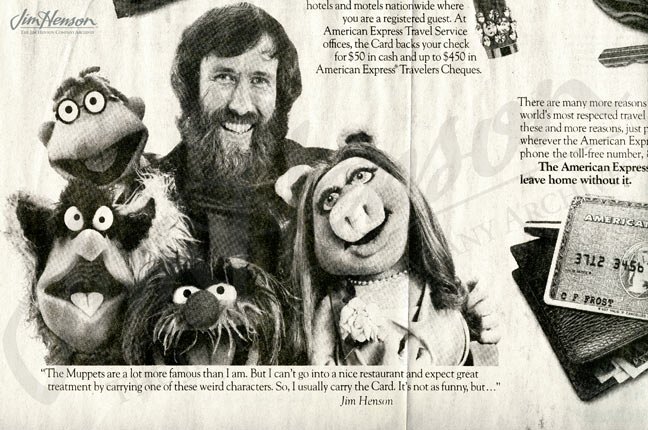
The films opened on a face in a chair asking whether you knew them. The subject listed what they had done - the voices behind cartoon characters, the thrillers, the clarinet, the vice-presidential campaign of 1964 - and dropped hints without ever giving a name. The name appeared at the end, embossed on the green card. Peter Thomas explained how to apply, and the card was signed off with the line that outlived the campaign.
The mechanism inverts ordinary celebrity advertising. Normally the famous face lends its credibility to the product; here the product supplies the identity the famous person is missing, which turns the card from a reward for status into the instrument that confers it. That also answered the fee without arguing about the fee, because a card that proves who you are is not in the same market as a card that is free. The roster carried the argument further than a slogan could: each new face was a fresh demonstration of the same idea, and by the time a New York Times Magazine advertisement gathered roughly thirty-three of them into one photograph, the device had become a public form that political posters and children's television were borrowing.
The work.
Film
Same shape of problem.
A card nobody could picture hired people nobody could place, and gave them their names back at the end.
Back to the archive →