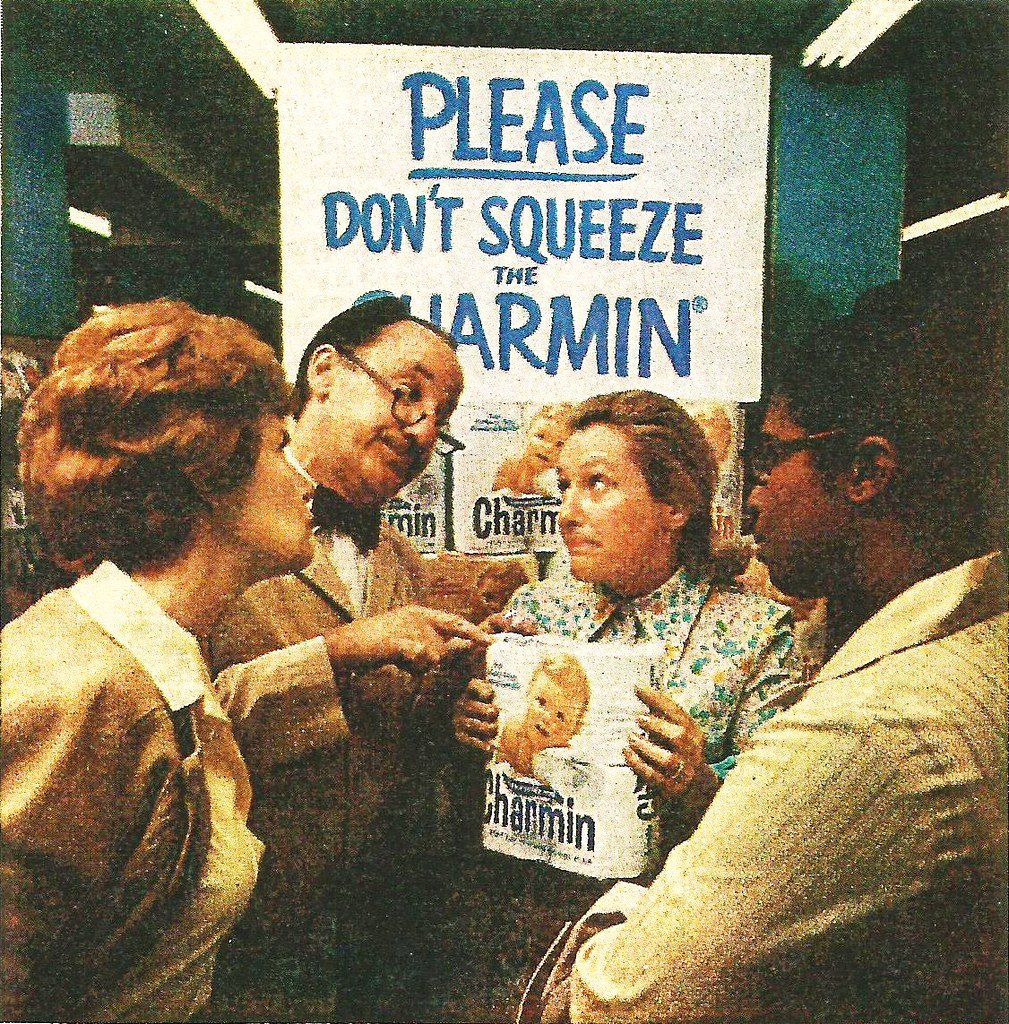
Please Don't Squeeze the Charmin
A commodity whose only advantage could not be shown built its demonstration out of a prohibition.
The era.
The supermarket had become the place where American brands were decided. Self-service retail put the goods within reach of the shopper and took the grocer out from between them, so the package, the shelf position and the advertising had to do the work a counter assistant used to do. Procter & Gamble bought the Charmin Paper Company of Green Bay, Wisconsin in 1957, and what it bought was a regional producer of facial and toilet tissues with no national presence. The company did not begin marketing Charmin nationally until 1971.
Paper goods were an unglamorous, crowded and slow-growing part of the store. Scott had held 38 per cent of the sanitary paper business in 1955 against a nearest competitor at 11 per cent, and through the 1950s its brands faced little opposition beyond Kleenex. That changed quickly: by 1966 Scott had five major competitors, and by 1970 toilet tissue had eleven, with supermarket private label gaining as well. Both tissue categories were mature and growing at roughly two per cent a year, which meant any share a brand gained had to be taken from somebody else.
Procter & Gamble ran its business through brand management, a system that set its own brands against each other and kept the people who ran them out of the public record. White Cloud, which the company also owned, sat in the same aisle as Charmin. Television was by then in nearly every household, and the company was among the heaviest advertisers in the country, with the reach to make a character familiar to the whole nation inside a few years.
The culture.
Toilet tissue was barely discussable in public, and its advertising showed it. Nineteenth-century makers sold medicated paper because bodily functions were not a subject; in the 1930s the category leaned on medical reassurance; through the 1950s advertisements still avoided the word toilet altogether. Scott's campaigns of the late 1920s warned that the wrong paper could cause serious trouble, possibly needing surgery. Northern's boast in 1935 was that its paper was splinter free. That was the standard the category was still clearing when Charmin started talking about how a roll felt in the hand.
The agency-built character was the dominant device of the period. Mr Clean, Josephine the Plumber for Comet and Madge the manicurist for Palmolive, who ran from 1968 to 1985, all did the same job: give a household product a face that could repeat an argument weekly without wearing out. A character lets an advertiser run hundreds of executions of a single claim, which is exactly what a low-interest product in a crowded aisle needs.
The target was the woman doing the weekly shop, and the campaign's insight came from watching her rather than from researching her. What she did in a supermarket was handle things - squeeze the melons, press the tomatoes, test the bread - because touch was the only way to judge them. Self-service had made that habit normal and had also made it a nuisance for the retailer, who did not want stock handled by people who might not buy it.
The problem.
Charmin's one real advantage was softness, and softness is a thing the hand knows and the eye does not.
Procter & Gamble bought the Charmin Paper Company of Green Bay in 1957 and acquired a regional producer with no national standing in a category that belonged to Scott. Toilet tissue was close to a commodity. The brands looked alike on the shelf, the category grew at about two per cent a year, and a shopper had no particular reason to reach past whichever roll was cheapest. Charmin's claim was that it was softer.
That claim was the problem, because softness cannot be photographed and cannot be filmed. A thirty-second commercial can show a package and say the word, and the word proves nothing. The one honest demonstration was to have people feel it, and that was the one thing no grocer would allow: an advertisement that told the public to handle packaged stock they might not buy would have been thrown out of the trade before it reached the shelf. The agency therefore needed a way to run the demonstration without issuing the instruction.
Procter & Gamble briefed Benton & Bowles in 1964 to demonstrate Charmin's softness. The agency's first proposal was to have shoppers squeeze the product the way they squeeze a tomato; because that risked objections from retailers who did not want stock handled, the idea was inverted into a comic grocer who forbids it. No published source names the Procter & Gamble brand manager who set the brief; the company's brand-management system kept client-side names out of public view.
The solution.
Make the forbidden act the whole advertisement, and hand the prohibition to a character who cannot resist it himself.
Benton & Bowles took the habit shoppers already had. John Chervokas, a junior copywriter on the account in 1964, started from what he had watched women do in a supermarket: squeeze the melons, the tomatoes and the bread to judge them, and he asked why the same test should not be used on the tissue. Because no grocer would tolerate that instruction, the agency turned it over and invented a grocer to forbid it. The prohibition did the demonstrating, and nobody had to be told to touch anything.
That inversion is why the idea lasted twenty-one years and more than five hundred films. A rule gives a story somewhere to go, so every execution could be the same demonstration performed by a man trying to prevent it, and the pay-off - George Whipple squeezing the roll himself once the customer has gone - turns the scold into the endorsement. Dick Wilson was cast in 1964 after an audition against thirty-three other actors and played the part until 1985. By 1975 he was being reported as the second best-known face in the country after the President, and in a 1978 survey the third best-known man in America. The work was widely disliked and for a period ranked last in believability, and Procter & Gamble says Charmin became the best-selling toilet paper in the United States by 1969.
The work.
Film
Same shape of problem.
The product's whole advantage was something you could only feel, so the advertising spent twenty-one years telling people not to touch it.
Back to the archive →